Many clients will often face the same dilemma: whether they are setting up a shop, office, or living area that requires a large capacity air conditioner (3HP - 5HP), should they choose a floor-standing air conditioner or a ceiling cassette unit? They both offer similar cooling capacities but differ in air distribution, installation method, maintenance, and space consumption. A wrong match may cause an unpleasant user experience and lead to high electricity bills or maintenance costs.
Here is a comprehensive comparison for both air conditioners and selection guidance for users.
I. Basic introduction for two air conditioners
Floor standing air conditioner
The standing air conditioning unit is placed on the ground with its air outlet in the middle and low position of the space. It supplies air with a single direction or wide angle with easy installation and without the demand of a ceiling, suitable for unfinished spaces, fully renovated interiors, or older properties. It is the most classic solution for large commercial and residential areas, covering a capacity range of 2HP to 10HP.
Ceiling cassette air conditioner
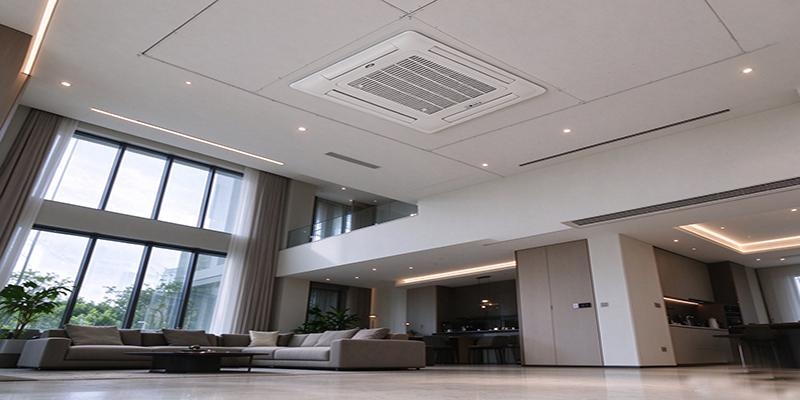
The ceiling cassette AC units are placed within the ceiling, being only exposed with a panel outside. It delivers air to four directions from the center of the room, belonging to the primary choice for commercial applications. Common capacities are 2HP, 3HP, 5HP, and 7HP.
II. Detailed comparison of core dimensions
1. Space and aesthetics
Floor standing air conditioner
It is placed on the ground in the corner, occupying the spaces for displays, furniture, or walkways with piping works exposed, offering a more traditional look. Choosing a floor-standing air conditioner, the ceiling height will not be impacted, and there will be no need for a dropped ceiling. It is ideal for spaces with around a 2.6 m ceiling height.
Ceiling cassette air conditioner
Its indoor unit is concealed with a dropped ceiling without occupying the ground space, ideal for retail shops, exhibition halls, and lobbies. It necessarily requires a dropped ceiling (25 cm height at least) with an access panel, which is not applicable for rooms with flat, solid ceilings or low overall ceiling heights.
2. Airflow and Temperature Control
Floor standing air conditioner
The height of the air outlet is similar to the height of a human, which allows it to sink cold air and lower the temperature quickly. However, with a fixed airflow direction, conditions will occur, like direct air blow in partial areas, a slow drop of temperature in distant areas, and an uneven temperature corner in large spaces. During heating mode in winter, warm air rises, which can make the heating effect feel less noticeable at the occupant level.
Ceiling cassette air conditioner
It supplies airflow in four directions (some models can supply 8 directions) with more even temperature in the room. It does not blow directly to the human body, offering a more comfortable experience in spaces with more people. However, it takes time to spread the cold air, and the initial cooling speed is slower than that of a floor-standing air conditioner. When heating in winter, the warm air will accumulate near the ceiling. The higher the ceiling, the more the heating effect at the lower is influenced.
3. Installation, Costs, and Timeline
Floor standing air conditioner
Easy installation with short turnaround. The initial cost for the equipment and installation is cheap with flexibility for relocation and upgrade.
Ceiling cassette air conditioner
The installation for the cassette air conditioner must proceed with the construction of the suspended ceiling. The piping for condensation must be reouted and reserved when preparing the plumbing and electrical works. Proper drainage slope is critical; otherwise, there will be leakage of water that would damage the ceiling. Additionally, there are more installation materials and the expense of the suspended ceiling. The total cost for the equipment and the whole installation is more expensive. And the machine is fixed and installed without the possibility to relocate freely.
4. Cleaning, Maintenance, and Failure Rates
Floor standing air conditioner
Filters are flexible to be cleaned by hand. As the circuitry, fan, and control board are built in together in the machine, the malfunction diagnosis and maintenance are easy without dismantling the interior finishes. It is an ideal option for shops that lack dedicated maintenance staff.
Ceiling cassette air conditioner
For cleaning, it needs to remove the panel at a height, and any issues related to leakage, motor failure, or electric control problems will need to dismantle the part of the suspended ceiling. Blockage of the drainage pipe is the most frequent maintenance issue, which is more demanding, and it is highly recommended to have the drainpipe cleared regularly.
5. Noise and Energy Consumption
For the air conditioners with the same cooling capacity, same brand, and same working conditions, there are slight differences between floor-standing and ceiling cassette air conditioners. For standing units, the fan is located near the floor, making the noise more noticeable when standing close by. For cassette air conditioners, they are concealed within the ceiling, resulting in a softer, less intrusive sound at ear level. On the energy efficiency level, neither type is absolutely more efficient. The power consumption is up to the using habits and environmental conditions, like cooling/heating load, the frequency of opening doors, the quality of thermal insulation, and the temperature settings.
III. Application cases
1. Occasions for choosing floor-standing air conditioners
Refreshing old buildings or adding AC to pre-finished homes where the customer does not want a suspended ceiling.
Buildings with a height of less than 2.65 m.
Tighten the budget for the short operation shop.
Small conference rooms and dining halls where fast partial cooling is demanded.
No dedicated staff for maintenance, so the customer wants to do it by themselves.
2. Occasions for choosing ceiling cassette air conditioners
Grosery stores, clothing shops, dining halls, showrooms, and other open-plan offices.
Square-shaped space with a large scale, open for the public, and with high foot traffic where direct air blow is prohibited and event temperature control is required.
The space has high value for displaying merchandise, tables, seating, etc.
Undergoing renovations with a dropped ceiling and aiming for a clean, high-end interior aesthetic.
To quickly select the type of air conditioner for your buildings, we can check the following questions: Whether the dropped ceiling is possible? Whether the ground space is treasuable? Whether the aftersales maintenance is convenient? The space with a dropped ceiling, the ground space is worthy for other purposes, the place is spacious with many people, then choose a ceiling cassette air conditioner; no dropped ceiling, additional purchasing for old houses, tighten budget, need easy maintenance, then choose a floor-standing air conditioner.
FAQ
Q1: Which one delivers better heating performance, a floor-standing cabinet unit or a ceiling cassette unit?
A: The floor-standing cabinet unit performs better. Hot air rises. For ceiling cassettes, hot air tends to accumulate near the ceiling, resulting in poor warmth at lower levels. The cabinet unit blows air from a low position, offering a more comfortable heating experience.
Q2: Which is easier to dismantle and reuse if you relocate later?
A: The floor-standing cabinet unit is simple to disassemble and easy to move. Ceiling cassettes are integrated with ceiling structures and drainage pipes. Removal and modification are troublesome, and ceiling repairs are usually required after dismantling.
Q3: Which option is suitable for retrofitting in an already renovated old house?
A: A floor-standing cabinet unit is preferred. It does not require custom ceiling work, features fast installation, and causes minimal damage to existing decorations.
Q4: Does the 4-way air outlet of a ceiling cassette blow air directly on people?
A: It has a much lower risk of direct airflow compared with the one-way outlet of a cabinet unit. The air deflector blades can adjust airflow direction. The air diffuses and sinks gently, making it ideal for public areas with many people.