{ Air Conditioner Manufacturer }

  • Does the Set Temperature Equal the Actual Indoor Temperature?

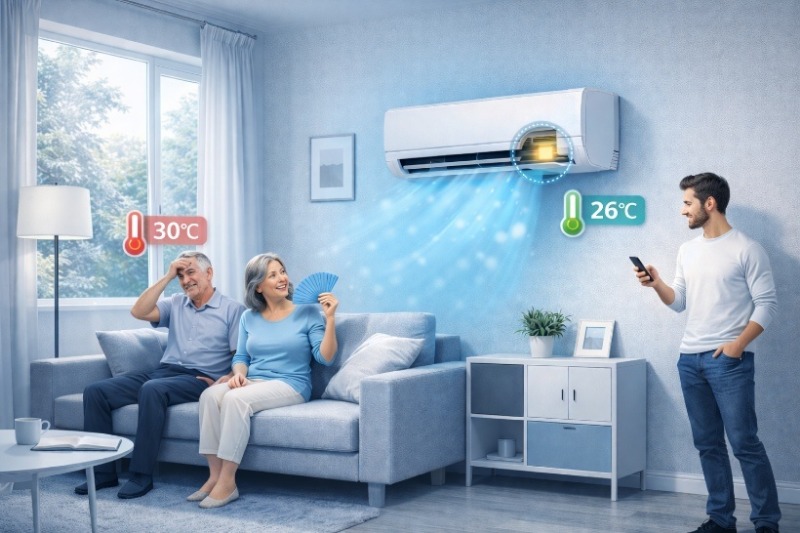
    Many people have the experience when using the air conditioner that we set a temperature at 26℃, but the room temperature is still not comfortable. Is that the error of the sensor or the air conditioner itself?

    The answer is that when the air conditioner is set to a temperature, it does not mean the temperature at every corner of the room. We are going to explain it clearly based on its mechanism.


    I. What exactly does the "set temperature" of an air conditioner measure?


    The air conditioner does not measure the whole room temperature, but it determines whether it needs continuous cool or heat by the sensor.

    In most of the wall mounted air conditioners or floor standing air conditioners, the temperature sensor is normally located near the air inlet of the indoor unit or inside the air inlet zone, which measures the air temperature near the air conditioner. This means that whether the air is conditioned to 26℃ or not depends not on the position where you are but on the area around the air conditioner.
     

    wall mounted air conditioners


    II. Why are there different temperatures in the same room at the same time?


    The temperature is not completely uniform even in the same room. There are factors that influence it: 


    1. Air stratification


    The cold air has high density, which tends to sink, while the hot air has a low density and tends to rise. As a result, the space that is close to the ground is colder, and the space that is close to the ceiling is hotter. That's why some feel cold on the feet and hot on the head and feel uncomfortable. With an air conditioner operating, people still feel uncomfortable.


    2. Building structure and insulation conditions


    West-facing walls, glass windows → continuous heat taken in

    Wide room space, high floor height → stronger thermal inertia

    Leakage in door gaps and window gaps → Continuous coolness loss

    All these will mislead the air conditioner to regard the cooling procedure as having reached the setting temperature, but the whole room is not truly stable.


    3. The relation between airflow and the human body position


    Direct air blow → More cooling;

    Back-wind zone or corners → Higher temperature;

    At the same 26℃, people sitting beneath the air outlet will feel cold, while those sitting at the corner will feel hot.


    III. Why is 26°C sometimes still cold?


    This is a common misconception among many people. Actually, the air conditioner is working between a temperature range instead of pursuing 26℃.

    For example, the setting temperature is 26℃, but the actual control range is 25℃ to 27℃. When the sensor detects the temperature lower than the limit (here 25℃), the compressor will slow its speed or stop working; when higher than the limit (here 27℃), the compressor will start to work again.

    If at this time, you sit near the direct air blow area or around the sensor, you will feel colder but with a not-so-low temperature setting.


    IV. Why do the inverter air conditioners seem more stable?


    Compared with normal non-inverter air conditioners, the advantages of the inverter air conditioners lie in the following facts:


    · The compressor speed is continuously adjustable;

    · The temperature fluctuation is lower;

    · The indoor airflow is more smooth and comfortable;


    This doesn't mean the inverter air conditioners measure the temperature more precisely, but when the air reaches the setting temperature, it works at a low power continuously instead of stopping working. Finally the indoor temperature becomes more uniform, and the experience of the human body is more comfortable.


    V. How to adjust the room temperature more reasonably?


    Instead of struggling over whether the temperature is precisely measured or not, we'd better focus on the comfort and the power consumption.


    Common advice:

    · Summer cooling temperature: 26-28℃;

    · Adopt with wind speed adjustment instead of lowering the temperature blindly;

    · Avoid long-time direct air blow;

    · Slightly close the window, curtains, and doors when there is poor tightness in the room;


    Noted: The air conditioner is to remove excessive heat, not to "create low temperature".
  • What Are "Return Air" and "Fresh Air"? Why Can't A Regular Air Conditioner Be Used As A Fresh Air System?

    When selecting or installing air conditioners, many people will hear two words, "return air" and "fresh air". But a more common question is, "As it blows air all the time, can an air conditioner supply the fresh air to the inside like a fresh-air machine?"


    The answer is absolutely not; most of the traditional air conditioners do not equal a fresh air machine. To understand the reason, we must know the basic distinctions between "return air" and "fresh air".


    I. Return air—A systematic indoor air-circulation


    Return air means there already exists air in the room; it is taken in and processed by the air conditioner and then returned to the room.


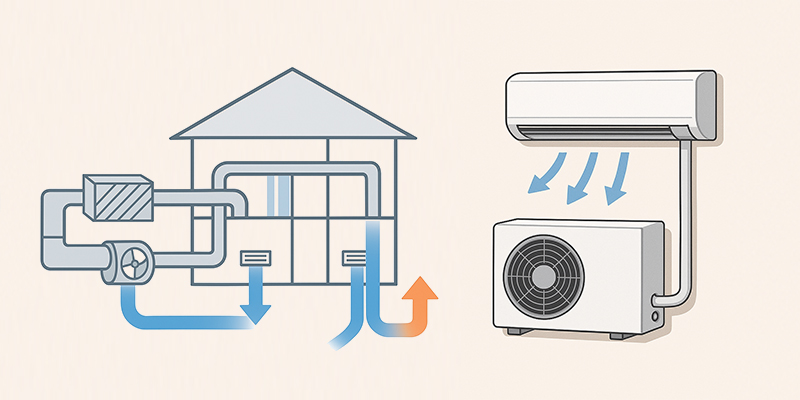
    The whole process is indoor air → being taken into the air inlet → passing through the filter → passing through the evaporator (cooling/heating) → blowing out from the air outlet.


    It features a source of air from indoors, a function of temperature adjustment, and a characteristic of hermetic or semi-hermetic circulation.


    The function of return air lies in the improvement of cooling and heating efficiency, the reduction of energy consumption (no need to cool the new air), and the even coverage of the room temperature. It stresses whether cooling and heating are comfortable rather than whether the air is fresh or not.


    II. Fresh air--- A true replenishment of outdoor air


    Fresh air means supplying air from the outdoors to indoors, in which the air has been filtered and processed.

    The whole process is outdoor air → air inlet → multiple filters (dust-proof, PM2.5, pollen, etc.) → heat recycle/cold recycle → fresh air supply to the indoors → dirty air exhaust to the outdoors in the meantime.

    It features a source of air from outdoors, a purpose of replenishing oxygen and diluting the dirty air, and a nature of air exchange.

    The fresh air can solve many health problems of the room, such as a high concentration of carbon dioxide, strange smells, formaldehyde, VOC, dirty air caused by long-term closed windows, and the lack of oxygen in confined spaces.


    III. Why can't traditional air conditioners be used as fresh air machines?


    1. Traditional air conditioners have no air inlet design from the outdoors


    Wall mounted air conditioners and floor standing air conditioners—their indoor units do not contact the air outside. The air inlet and air outlet are all inside of the room. The outdoor units are only responsible for heat dissipation.

    The new air didn't come in, and the air just circulates inside.


    2. Air-conditioned wind is not same with fresh air


    Some people believe that it seems the air is fresh when the air conditioner is turned on and the air flows. But in fact, only the air circulates; the content of oxygen does not increase, and carbon dioxide and strange smells accumulate in the room continuously.

    That's why people will get tired and have headaches in the air-conditioned room for a long time, and offices need to open the window regularly or install a fresh air system.


    3. Traditional air conditioners don't have filtration and protections that a fresh-air system requires


    A true fresh-air system needs high-efficiency filtration (dust-proof, PM2.5, pollen, etc.), anti-condensation, anti-backflow design, and pressure control between indoor and outdoor.

    Traditional air conditioners have a filter, but it is only used for dust-proofing, which cannot process the outdoor polluted air directly. If we insist on supplying the air from the outside, it may lead to condensation, a surge in energy consumption, and even malfunctions.


    IV. Is there a win-win plan that covers air conditioning and fresh air needs?


    The answer is YES, but they are not traditional air conditioners. Here are applicable solutions:


    · Air conditioner + individual fresh-air system (Common and stable plan);

    · Central air conditioning/ducted air conditioning with fresh air function;

    · Full heat exchange fresh air + air conditioning system.


    Those systems had taken into consideration fresh air volume, energy consumption balance, and heat/cool compensation during the designing process.


    Wall Mounted Air Conditioner


    V. In which conditions should we choose a fresh-air system


    If you meet the following situations, a fresh-air system is not optional but a must.


    · Long-term hermetic spaces (closed windows)

    · Offices, hotels, apartments

    · Live with the elderly, kids, and pregnant women.

    · High pursuit of the air quality (allergies, dust, formaldehyde)


    The core task of the air conditioners is to adjust the room temperature, while the fresh-air system is to refresh the air. They are not in a relation of replacement but of complementarity. If you only install the air conditioner, your room will be cool and heated, but if you have a fresh-air system at the same time, your room will be alive.