{ Split Air Conditioner Manufacturer }

  • How Does The Refrigerant Move And Achieve Cooling/Heating Inside of The Copper Pipes?

    Many people may ask a question that seems simple: Why can the air conditioner cool once it connects to the power supply? And what happened inside of the copper pipe?

    The answer is the refrigerant circulation. The key point of cooling is not the cold air itself, but the continuous flow, phase transition, and energy transportation process of the refrigerant inside the copper pipes.


    I. An air conditioner is not to "create cold" but to "transfer heat."


    Here is a common misconception to clarify: the basis of the air conditioner is not to produce cooling but to remove heat from interior to exterior. While the "deliveryman" is the refrigerant that flows inside the copper pipe. The tube is just the vessel; what actually contributes to the cooling process is the absorption and releasing of the energy at the different states of the refrigerant.


    II. Why is "copper" pipe necessarily needed?


    Being selected as the piping material of the cooling system benefits from its three advantages:


    Good thermal conductivity: it conduces to the heat exchange of refrigerant and air.

    High-temperature and corrosion resistance: it adapts to the frequent exchange of the refrigerant in high- and low-pressure conditions.

    High reprocessability with reliable hermeticity: it is easy to weld and bend, reducing the risk of leakage.


    III. 4-steps circulation of the refrigerant in copper pipe


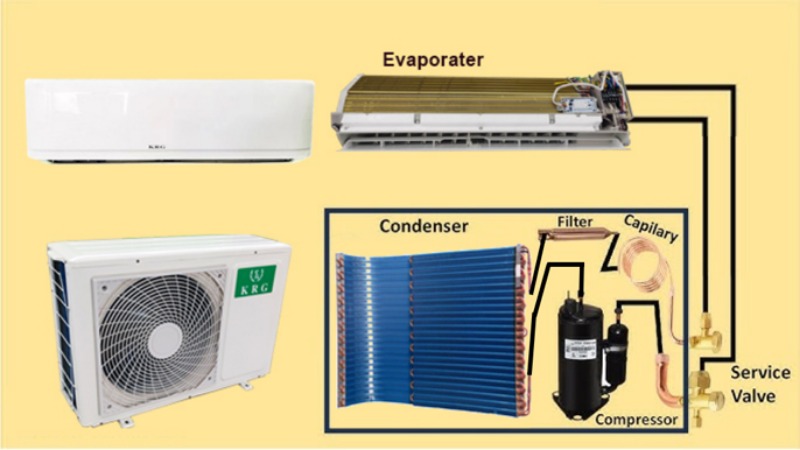
    1. Compressing: convert low-pressure gas into high-pressure, high-temperature gas


    At a state of low pressure and low temperature, the refrigerant is sucked in by the compressor; after being compressed, it becomes high pressure and high temperature. At this time, the temperature of the refrigerant is much hotter than outside of the room.


    2. Condensing: release heat outside, convert refrigerant from gas to liquid


    The high-pressure, high-temperature refrigerant (gas state) goes into the condenser (copper pipe + fins), changing from a gas state into a liquid state and releasing heat to the air outside through copper pipes.

    The key point here is the process from gas to liquid will release much heat.


    3. Throttling: sudden decrease of pressure, preparing for the heat absorption


    Being condensed, the refrigerant becomes high pressure with a medium temperature but in a liquid state.

    After passing through a small part (capillary or electronic expansion valve), the refrigerant pressure decreases suddenly, and together with the temperature, it becomes a low-temperature, low-pressure state mixed with gas and liquid.


    4. Evaporating: absorb heat inside, create "cooling"


    The low-pressure, low-temperature refrigerant (gas state) goes into the evaporator (copper pipe + fins). At this time the indoor temperature is higher than the refrigerant, which absorbs heat from the refrigerant through copper pipes and changes from a liquid state into a gaseous state.

    Evaporating is the process of absorbing heat, so that's why the indoor air has been cooled.


    IV. Why is the phase transition so important to the refrigerant?


    If the refrigerant uses normal liquid or gas, then the cooling efficiency will be very low.

    Absorbing or releasing a large amount of potential heat during the phase transition is the biggest value for the refrigerant. With the same temperature difference, it will transfer more heat than normal substances.

    That's why, by flowing backwards and forwards in the copper pipe, a little refrigerant could cool and heat the whole room.


    V. Heat exchange efficiency depends on the design of copper deeply


    Whether the refrigerant could work efficiently, it not only depends on itself but also on if:


    The copper pipe size is reasonable;

    The piping length is suitable;

    The fins structure and the distance between pipes;

    The inside surface of the copper pipe is clean and oil-free;

    Those details will directly affect the cooling speed, COP/EER, systematic stability, and lifespan.
     

  • Why Does the Air Conditioner Outdoor Unit "Smoke" in Winter? A Brief Introduction of Defrosting Mode.

    In every winter, many users will face a phenomenon that when the air conditioner operates in heating mode, the outdoor unit will blow a batch of smoke, and sometimes there are sounds of water flow and shutdown of the motor. It seems the machine has malfunctions.

    Actually, most of the time this is not a failure but the operation of the auto defrost mode of the air conditioner. Here we will explain why it smokes in winter, how the defrost mode operates, and if it is harmful to the equipment.


    I. How does the air conditioner heat in winter?


    Under heating mode, the room air conditioner indoor unit performs as a condenser to release heat, while the outdoor unit acts as an evaporator to absorb heat. It brings energy from exterior to interior. Though the exterior temperature is 0℃, the air still contains energy, and the compressor could extract this part of the heat through refrigerant circulation.


    II. Why does frost form on outdoor surfaces?


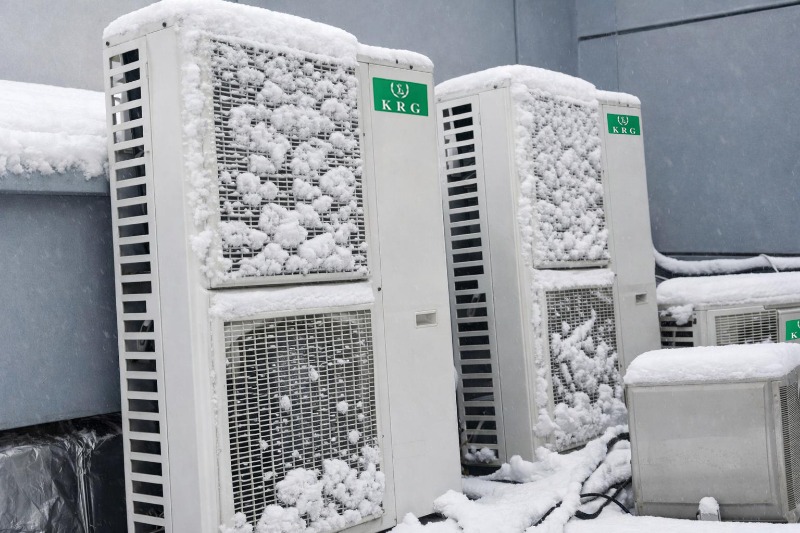
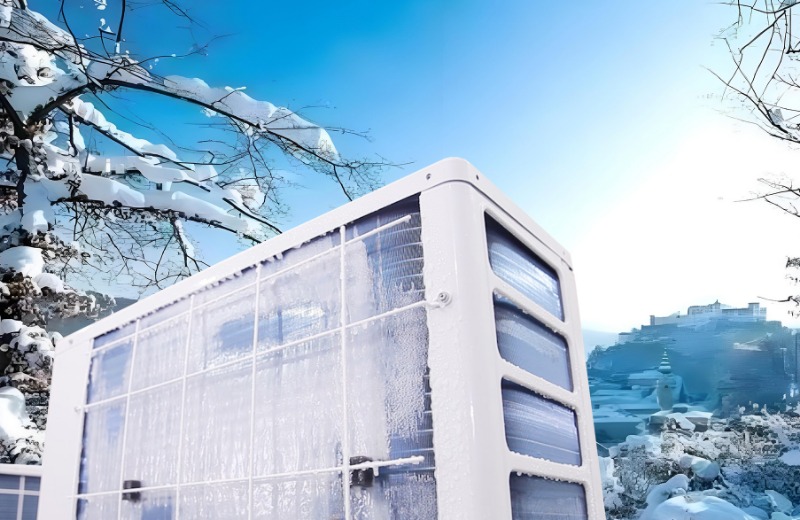
    When the temperature is low and the humidity is heavy outdoors, the surface temperature of the outdoor unit heating exchanger will be lower than 0°C. The steam in the air will condense under lower temperatures and form frost on the exchanger surface gradually.

    Particularly during 0℃ to 8℃ rainy days in high-humidity areas, it is easier to frost.

    The frost covering on the heat exchanger fins will lead to lower heat-exchange efficiency and weaker heating ability as a result of high energy consumption. If it remains without action, the heating performance will be worse and worse.


    III. What's the Defrosting Mode?


    When the detected frost reaches a level, the air conditioner will start the defrost process automatically.

    This function is easy; the air conditioner compressor will temporarily convert the rotating direction and the cooling cycle.

    This means the normal heating mode in the room will convert to heat the outdoor unit, melting the frost by using the high-temperature refrigerant in the copper pipe.

    This procedure will last 3-10 minutes, which is a common protection mechanism for air conditioners.


    IV. Why can we see white smoke?


    When the frost is melted by hot refrigerant quickly, it becomes water; some water is heated to evaporate, becoming steam; hot steam and cold air condensate and form plenty of small and slim water fogs, which look like smoke.


    In the meantime, you will see the outdoor fan stop working, the indoor unit stop supplying air, and hear sounds of water flow, which are all common phenomena.


    V. Why does the indoor unit not heat during the defrost procedure?


    When defrosting, the system is heating for the outdoor unit, and the indoor unit stops supplying air. This is to avoid blowing cold air indoors in winter and improve defrosting efficiency. Some air conditioners will show "DF" or "H1" or a defrosting symbol. After defrosting is finished, the air conditioner will resume heating automatically.


    VI. Is frequent defrosting normal?


    Based on the environmental conditions, in extremely cold and high-humidity weather, it defrosts once every 40-90 minutes normally.

    If defrosting occurs every 10 minutes, or the heating is obviously insufficient, or the outdoor unit freezes heavily, it would be a lack of refrigerant, sensor failure, or the blockage of the drainage pipe. At this time, it is suggested to arrange professional examination and maintenance.


    VII. How to reduce frequent defrosting?


    1. Ensure good ventilation for the outdoor unit;

    2. Ensure drainage unobstructed;

    3. Avoid frequent start-ups;

    4. Set a reasonable temperature. (22-24℃).


    We are a professional air conditioner manufacturer in China. Should you have any other questions in the industry, please don't hesitate to reach us!