{ Wall Mounted Air Conditioner Supplier }

  • What Are the Differences Between Air Speed, Air Volume, and Air Pressure?

    Sometimes, people comment on an air conditioner that it has high air volume but it's not cold, or it operates loudly but the room temperature decreases slowly, or the air speed is strong but there is no feeling in a distant place.

    Behind these experiences, they are related to three conceptions that are easily confused: air speed, air volume, and air pressure. They are at different levels but determine the comfort, air supply distance, and cooling performance at the same time.


    I. What is air speed? -- the wind that you had experienced


    Air speed is the velocity of the airflow with the common unit of m/s (meters per second). To put it simply, air speed determines how strong the wind blows on your face when you stand in front of the air outlet.

    The higher the air speed, the more significant the feeling of airflow; and the lower the air speed, the smoother the airflow would be. In the air conditioning, a high air speed does not mean quicker cooling; instead, it will form a feeling of direct air flow and produce noise and discomfort.


    II. What is air volume? -- the key to determine the cooling efficiency


    Air volume refers to the volume of the supplied air in the unit time with a unit of m³/h or ft³/h (cubic meters per hour, cubic feet per hour). To put it simply, air volume determines how much of the air has been processed and joined in the cooling circle.

    The higher the air volume, the quicker the air circulation inside, and the more even the overall temperature will be; on the contrary, the lower the air volume, the less even the temperature will be.


    III. What is air pressure? -- the ability to supply the air to a distance


    Air pressure, or static pressure, refers to the ability of the system to overcome the resistance; the unit is Pa. Simply, it determines whether the air would spread to a long distance and across the obstacles with stability.

    Air pressure is the key index to the central air conditioners and ducted air conditioners. Insufficient pressure will make the air strong near the vent but weak while far from the vent, and the longer the vent, the worse the cooling performance will be. Sufficient air pressure will provide an even air volume at every vent and supply air stably in the large spaces.
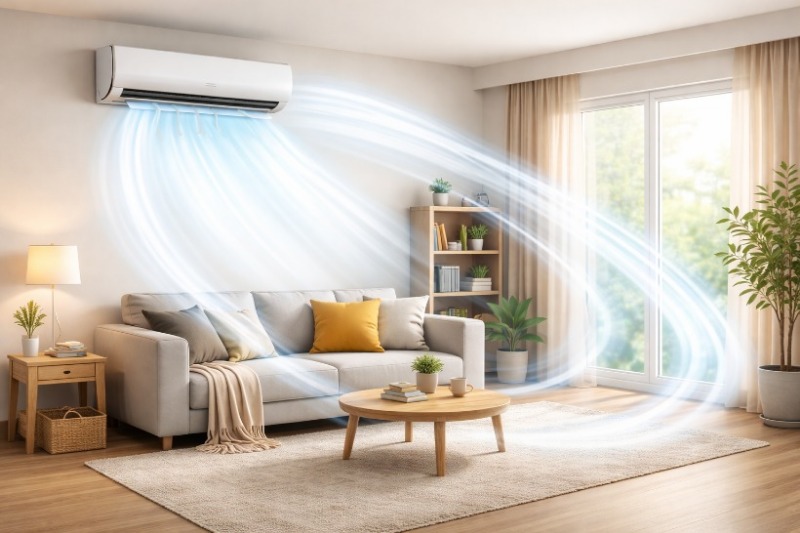


    IV. The relationship between them is not "the bigger the better" but a match


    There is a common misconception that the stronger the air blow, the better the air conditioner will be. In fact, high air speed with small air volume and low air pressure will only make it cool around the air outlet. Reasonable air speed with high air volume and enough air pressure will make the whole room have an even and comfortable temperature.


    Item

    What it determines

    Situation when at a high level
    Airspeed The feeling of air (strong/weak) Discomfort, loud noise
    Air volume Cooling efficiency High energy consumption
    Air pressure Air supply distance Systematic noise and high energy consumption


    V. Reasons why our air conditioner is not comfortable


    1. Large room with small air volume: the cooling process is slow and the temperature difference is large.

    2. Inadequate static pressure: for the ducted air conditioners, this situation will lead to no wind at the air outlet.

    3. Force to increase the air speed: the higher the wind, the louder the noise, and the easier it is to get a headache.


    VI. How to choose among these parameters?


    · Wall mounted air conditioner/floor standing air conditioner

    Focus on whether the air volume matches with the room size. The wind needs to be smooth instead of being strong.


    · Ceiling cassette air conditioner/ducted air conditioner/central air conditioner

    The air pressure is the key point. Models with multiple vents and long pipes should come with high static features.


    · Inverter air conditioners

    Inverter models are ideal options for various spaces; they can adjust the load automatically, saving energy and providing comfort.


    We are professional air conditioner manufacturers. For more information on specifications of the air conditioners, please feel free to contact us!
  • What Are "Return Air" and "Fresh Air"? Why Can't A Regular Air Conditioner Be Used As A Fresh Air System?

    When selecting or installing air conditioners, many people will hear two words, "return air" and "fresh air". But a more common question is, "As it blows air all the time, can an air conditioner supply the fresh air to the inside like a fresh-air machine?"


    The answer is absolutely not; most of the traditional air conditioners do not equal a fresh air machine. To understand the reason, we must know the basic distinctions between "return air" and "fresh air".


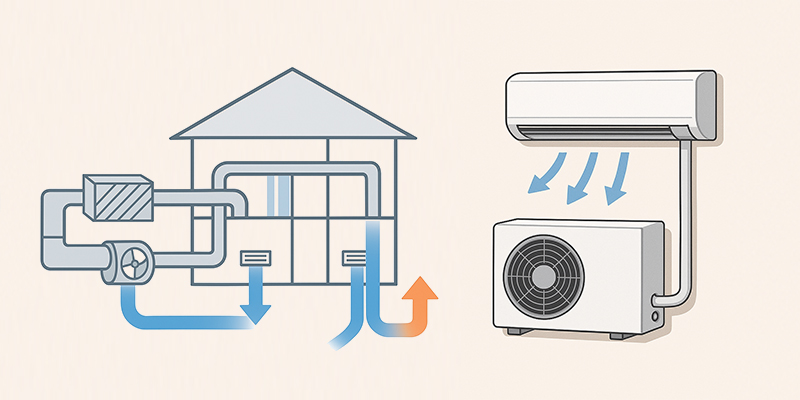
    I. Return air—A systematic indoor air-circulation


    Return air means there already exists air in the room; it is taken in and processed by the air conditioner and then returned to the room.


    The whole process is indoor air → being taken into the air inlet → passing through the filter → passing through the evaporator (cooling/heating) → blowing out from the air outlet.


    It features a source of air from indoors, a function of temperature adjustment, and a characteristic of hermetic or semi-hermetic circulation.


    The function of return air lies in the improvement of cooling and heating efficiency, the reduction of energy consumption (no need to cool the new air), and the even coverage of the room temperature. It stresses whether cooling and heating are comfortable rather than whether the air is fresh or not.


    II. Fresh air--- A true replenishment of outdoor air


    Fresh air means supplying air from the outdoors to indoors, in which the air has been filtered and processed.

    The whole process is outdoor air → air inlet → multiple filters (dust-proof, PM2.5, pollen, etc.) → heat recycle/cold recycle → fresh air supply to the indoors → dirty air exhaust to the outdoors in the meantime.

    It features a source of air from outdoors, a purpose of replenishing oxygen and diluting the dirty air, and a nature of air exchange.

    The fresh air can solve many health problems of the room, such as a high concentration of carbon dioxide, strange smells, formaldehyde, VOC, dirty air caused by long-term closed windows, and the lack of oxygen in confined spaces.


    III. Why can't traditional air conditioners be used as fresh air machines?


    1. Traditional air conditioners have no air inlet design from the outdoors


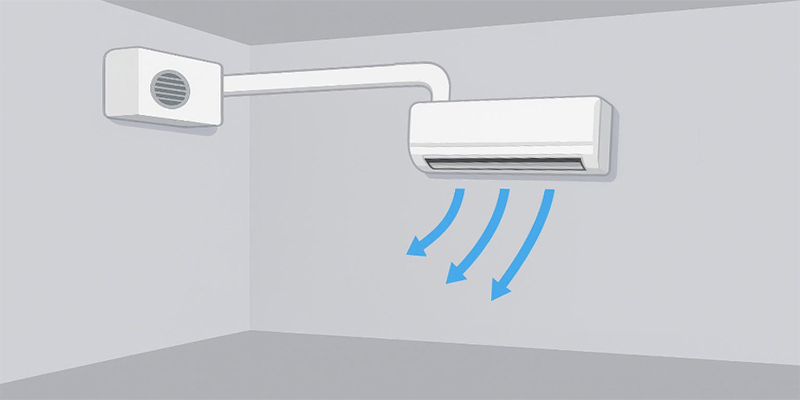
    Wall mounted air conditioners and floor standing air conditioners—their indoor units do not contact the air outside. The air inlet and air outlet are all inside of the room. The outdoor units are only responsible for heat dissipation.

    The new air didn't come in, and the air just circulates inside.


    2. Air-conditioned wind is not same with fresh air


    Some people believe that it seems the air is fresh when the air conditioner is turned on and the air flows. But in fact, only the air circulates; the content of oxygen does not increase, and carbon dioxide and strange smells accumulate in the room continuously.

    That's why people will get tired and have headaches in the air-conditioned room for a long time, and offices need to open the window regularly or install a fresh air system.


    3. Traditional air conditioners don't have filtration and protections that a fresh-air system requires


    A true fresh-air system needs high-efficiency filtration (dust-proof, PM2.5, pollen, etc.), anti-condensation, anti-backflow design, and pressure control between indoor and outdoor.

    Traditional air conditioners have a filter, but it is only used for dust-proofing, which cannot process the outdoor polluted air directly. If we insist on supplying the air from the outside, it may lead to condensation, a surge in energy consumption, and even malfunctions.


    IV. Is there a win-win plan that covers air conditioning and fresh air needs?


    The answer is YES, but they are not traditional air conditioners. Here are applicable solutions:


    · Air conditioner + individual fresh-air system (Common and stable plan);

    · Central air conditioning/ducted air conditioning with fresh air function;

    · Full heat exchange fresh air + air conditioning system.


    Those systems had taken into consideration fresh air volume, energy consumption balance, and heat/cool compensation during the designing process.


    Wall Mounted Air Conditioner


    V. In which conditions should we choose a fresh-air system


    If you meet the following situations, a fresh-air system is not optional but a must.


    · Long-term hermetic spaces (closed windows)

    · Offices, hotels, apartments

    · Live with the elderly, kids, and pregnant women.

    · High pursuit of the air quality (allergies, dust, formaldehyde)


    The core task of the air conditioners is to adjust the room temperature, while the fresh-air system is to refresh the air. They are not in a relation of replacement but of complementarity. If you only install the air conditioner, your room will be cool and heated, but if you have a fresh-air system at the same time, your room will be alive.