{ China Air Conditioner Manufacturer }

  • What Factors Influences The Air Conditioner Cooling Capacity?

    When people buy air conditioners, most of them are concerned about the cooling capacity. However, during the actual operations, the same 12000 BTU split air conditioners may differ in cooling performance, apparently. This is because the actual cooling ability does not depends on the product itself; instead, it is affected by the working conditions, installation, operation statistics, etc.

    This article is to introduce the key factors that influence the air conditioner's cooling capacity and help people better choose a product that suits their needs and get the best utilization performance.


    I. What is the cooling capacity of an air conditioner?


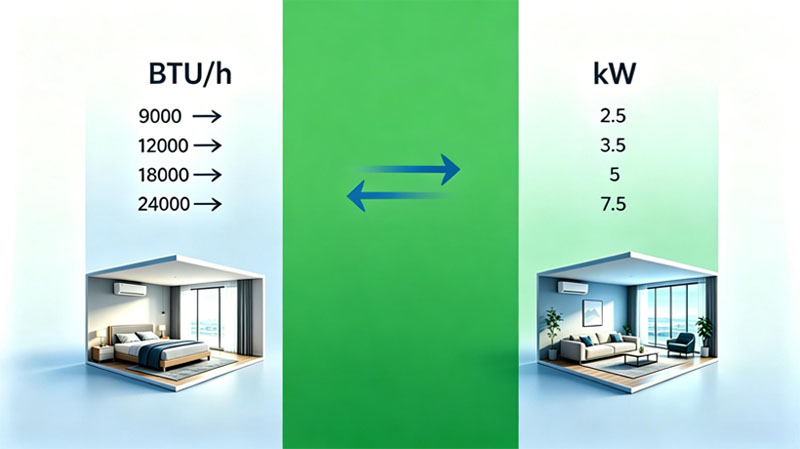
    Cooling capacity is the ability of the air conditioner to remove heat from the interior to the exterior in a unit of time. Common units are BTU/h (British Thermal Unit Per Hour) and kW (kilowatt).


    Examples:

    9000 BTU ≈ 2.5 kW

    12000 BTU ≈ 3.5 kW

    18000 BTU ≈ 5 kW

    24000 BTU ≈ 7.5 kW

    The more powerful the cooling capacity, the larger the space the air conditioner will cover.


    II. Key factors that influences the cooling performance


    1. The exterior ambient temperature

    The ambient temperature is the most important key factor that influences the air conditioner cooling capacity. The air conditioner releases heat to the outside through the outdoor unit. If the outside ambient temperature rises, the condensing pressure will increase, which will lead to higher compressor load and lower heat-exchanging efficiency. In case of that, the actual cooling capacity will gradually decrease.


    Examples:

    Testing cooling capacity is 100% under the ambient temperature of 35 ℃;

    When the ambient temperature goes up to 46 ℃,  the testing cooling capacity may decrease to 85%-95%;

    Under the extreme environment of 52°C, it may decrease to 70%-85%.


    This is why in the high-temperature areas, people tend to choose T3-type air conditioners more.


    2. The room size and the height

    The larger the room, the more heat it needs to be removed. Except for the room size, the height is also important.

    Examples:


    Room 1: 20 m² with a height of 2.8 m;

    Room 2: 20 m² with a height of 4.5 m.


    Their sizes are the same, but room 2 has 60% more air volume, which will require more cooling capacity. For warehouses, shops, and exhibition halls, the cooling capacity depends on the actual volume instead of the floor size.


    3. The insulation performance of the building

    The housing structure of the building will continue to spread heat to the indoor environment. The factors include the thickness of walls, the insulation quality, the rooftop insulation performance, and the material of doors and windows. The buildings with poor insulation performance will bring more cooling load.


    Examples:

    Single-story sheet-metal factory building

    Container office

    Building with extensive glass curtain walls


    These conditions normally require an air conditioning system with higher capacity.


    4. Sunlight intensity

    The sunlight will increase the interior heat apparently, particularly for west-facing rooms, south-facing glass curtain walls, and top-floor rooms.

    The solar radiant heat can reach up to 20% of the total cooling burden. As for the areas with strong sunlight, it is recommended to increase the cooling capacity.


    5. The number of people in the room

    The human body is the source of heat. Commonly, each adult can generate about 100~150W heat per hour. Particularly in the offices, conference rooms, classrooms, restaurants, and shopping malls.

    When the occupant density is increased, the air conditioner needs to shoulder the cooling burden from the human bodies additionally.


    6. Heat from the devices

    Many electric devices will release heat during their operations. Such as computers, databases, televisions, lighting equipment, kitchen equipment, etc.

    In the spaces like server rooms, monitoring centers, and commercial kitchens, the heat generated by the devices is greater than that of the human body. In such conditions, it is necessary to check the cooling capacity again according to the actual heating burden.


    7. The piping length and the installation

    No matter how perfect the air conditioner is, irregular installation will still affect its cooling capacity.

    Common issues are:

    Too long copper pipe;

    Poor insulation;

    Refrigerant leakage;

    Insufficient vacuum-pumping;

    Too many elbows on the copper pipe.

    These problems will lead to:

    Loss of cooling capacity;

    Increased pressure drop;

    Increased energy consumption.


    Finally, the actual cooling performance does not reach the designed level.


    8. Charge of refrigerant

    Refrigerant is the key medium of air conditioners to transfer heat. If the refrigerant is insufficient, then the heat-exchanging ability of the evaporator will decrease as well as the cooling capacity. But if the charge of refrigerant is too much, then the system pressure will be irregular, which will increase the compressor burden.


    9. The cleanliness of air filter

    Blocks on the air filter will obstruct air circulation. This may lead to lower airflow, frost on the evaporator, and lower cooling ability.

    If the air filter has not been cleaned for a long time, the cooling efficiency of the air conditioner will decrease about 10% and more. Regular maintenance will help to keep the air conditioner at the best performance.


    10. Stability of power supply

    Abnormal voltage will directly influence the operation of the compressor and fan motor. When the voltage is low, the power output of the motor will decrease, and the compressing efficiency will decrease as well. In the areas where the power supply is unstable, it is recommended to equip with a voltage regulator or choose the air conditioners that are available with wide voltage (180V-230V).


    The actual cooling capacity of the air conditioner is not fixed, but it is affected by multiple factors simultaneously. When choosing air conditioners, it is not enough to only be concerned with the number (BTU). Taking the working environment and actual cooling burden into consideration comprehensively, we will gain the best experience in comfort, energy efficiency, and cost advantage on long-term operation. We are a professional air conditioner manufacturer in Guangzhou, China. If you have any questions related to your room cooling solutions, please don't hesitate to contact us.
  • What Are the Differences Between Air Speed, Air Volume, and Air Pressure?

    Sometimes, people comment on an air conditioner that it has high air volume but it's not cold, or it operates loudly but the room temperature decreases slowly, or the air speed is strong but there is no feeling in a distant place.

    Behind these experiences, they are related to three conceptions that are easily confused: air speed, air volume, and air pressure. They are at different levels but determine the comfort, air supply distance, and cooling performance at the same time.


    I. What is air speed? -- the wind that you had experienced


    Air speed is the velocity of the airflow with the common unit of m/s (meters per second). To put it simply, air speed determines how strong the wind blows on your face when you stand in front of the air outlet.

    The higher the air speed, the more significant the feeling of airflow; and the lower the air speed, the smoother the airflow would be. In the air conditioning, a high air speed does not mean quicker cooling; instead, it will form a feeling of direct air flow and produce noise and discomfort.


    II. What is air volume? -- the key to determine the cooling efficiency


    Air volume refers to the volume of the supplied air in the unit time with a unit of m³/h or ft³/h (cubic meters per hour, cubic feet per hour). To put it simply, air volume determines how much of the air has been processed and joined in the cooling circle.

    The higher the air volume, the quicker the air circulation inside, and the more even the overall temperature will be; on the contrary, the lower the air volume, the less even the temperature will be.


    III. What is air pressure? -- the ability to supply the air to a distance


    Air pressure, or static pressure, refers to the ability of the system to overcome the resistance; the unit is Pa. Simply, it determines whether the air would spread to a long distance and across the obstacles with stability.

    Air pressure is the key index to the central air conditioners and ducted air conditioners. Insufficient pressure will make the air strong near the vent but weak while far from the vent, and the longer the vent, the worse the cooling performance will be. Sufficient air pressure will provide an even air volume at every vent and supply air stably in the large spaces.


    IV. The relationship between them is not "the bigger the better" but a match


    There is a common misconception that the stronger the air blow, the better the air conditioner will be. In fact, high air speed with small air volume and low air pressure will only make it cool around the air outlet. Reasonable air speed with high air volume and enough air pressure will make the whole room have an even and comfortable temperature.


    Item

    What it determines

    Situation when at a high level
    Airspeed The feeling of air (strong/weak) Discomfort, loud noise
    Air volume Cooling efficiency High energy consumption
    Air pressure Air supply distance Systematic noise and high energy consumption


    V. Reasons why our air conditioner is not comfortable


    1. Large room with small air volume: the cooling process is slow and the temperature difference is large.

    2. Inadequate static pressure: for the ducted air conditioners, this situation will lead to no wind at the air outlet.

    3. Force to increase the air speed: the higher the wind, the louder the noise, and the easier it is to get a headache.


    VI. How to choose among these parameters?


    · Wall mounted air conditioner/floor standing air conditioner

    Focus on whether the air volume matches with the room size. The wind needs to be smooth instead of being strong.


    · Ceiling cassette air conditioner/ducted air conditioner/central air conditioner

    The air pressure is the key point. Models with multiple vents and long pipes should come with high static features.


    · Inverter air conditioners

    Inverter models are ideal options for various spaces; they can adjust the load automatically, saving energy and providing comfort.


    We are professional air conditioner manufacturers. For more information on specifications of the air conditioners, please feel free to contact us!

  • Can an Air Conditioner Operate Under -40℃?

    To those living in extremely cold regions, a common question comes when it is needed to heat by an air conditioner in winter: can the air conditioner outdoor unit operate freely in an extremely cold environment or not? Particularly under the ultra-low temperatures of -30℃ and -40℃, is the air conditioner able to supply reliable heat?


    1. What are the limits of traditional air conditioners?


    Traditional non-inverter or inverter air conditioners are available to operate under the ambient temperature of -7℃ to -15℃. When the temperature goes further lower, the situations below will occur:


    i). Apparent decrease of heating capacity;

    ii). Severe frost on the outdoor unit and defrosting affect heating performance.

    iii). The compressor is hard to start or does not even start.


    In case of that, traditional air conditioners can not start freely under the temperature of -30℃ and even -40℃.


    2. Advanced technology: EVI technology


    For cold regions, air conditioner manufacturers will develop the air conditioner models with EVI (Enhanced Vapor Injection) technology. By adding additional jet ports for gas in the compressor, the technology allows the refrigerant to keep enough pressure and flow under the extreme cold condition, improving the heating ability under low temperature. Adopted with EVI technology, the air conditioners could provide stable heating under -25℃ to -30℃ environments. Some high-end models are claimed to start freely under -35℃.


    3. Impossibility under -40℃


    Under a -40℃ environment, even the high-end air conditioning models are still facing great challenges:


    i). The starting difficulty: Thickening of the refrigerant oil makes it difficult to lubricate the compressor.

    ii). The decreasing heating capacity: Even if the system can start, the heating capacity will be significantly reduced.

    iii). The increasing power consumption: Even if the system can start, the heating capacity will be significantly reduced.


    Common solutions to the -40℃ environments are ultra-low temperature air source heat pumps (customized commercial/engineering machines), rather than ordinary household air conditioners, or electric auxiliary heating and gas heating with air conditioning used in conjunction.


    4. Options for the cold areas.


    For regions in the Mongolia plateau, Northern Russia, and Canada, it is recommended to choose low-temperature heat pump air conditioners with EVI technology or directly choose air source heat pump heating units, whose operating limit can be extended to -35℃ or even -40℃, or combine them with backup heating methods such as floor heating and electric heaters to ensure comfort and safety in extreme weather.


    Traditional air conditioners can't start at -40°C. Even some high-end low-temperature heat pump models claim to be able to operate, but they require extremely demanding technical support and operating environments. For users in extremely cold regions, choosing a professional ultra-low-temperature heat pump product is the only reliable way to heat your home in winter.