What's the Difference Between 50Hz and 60Hz Air Conditioners?
In the export and international trade of air conditioners, many customers may ask a question: What's the difference between 50 Hz and 60 Hz air conditioners? Are they compatible?
Actually, Hz (hertz) refers to the frequency of the power grid. Different countries have different frequencies, which directly influence the compressor, motor speed, and the overall performance of the air conditioners. This is very important for air conditioner importers and buyers.
I. What are 50Hz and 60Hz?
The frequency of a power grid refers to the number of times the alternating current changes per second.
50 Hz: It changes 50 times per second;
60 Hz: It changes 60 times per second.
Simply, 60Hz current changes faster than 50Hz.
There are two major power grids in the world:
50 Hz countries: China, Europe, the Middle East, Africa, Southeast Asia, etc.
60 Hz countries: America, Canada, Japan, South Korea, the Philippines, part of Saudi Arabia, etc.
II. Influences on the compressor speed
Basically, an air conditioner compressor is motor-driven equipment, while the power grid frequency will directly affect the motor speed.
The theoretical speed formula for an electric motor is: Speed ≈ 120 × Frequency ÷ Number of poles. So a 60Hz motor has a speed of 20% more than a 50Hz one.
An improved motor speed will bring us the improvement of cooling capacity, cooling power, and energy consumption.
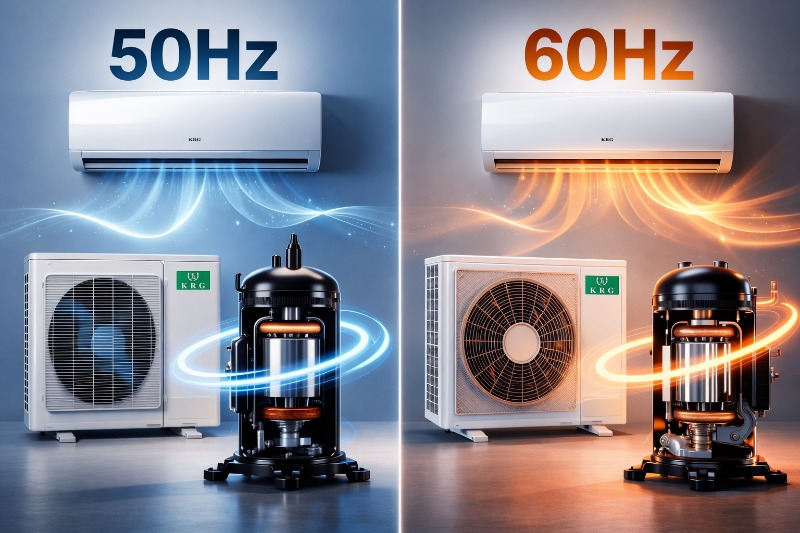
III. Influences on the performance of air conditioner
1. Cooling capacity
A same-capacity air conditioner, converting the operation from 50 Hz to 60 Hz, will have its cooling capacity increase about 15%-20%.
For example, the cooling capacity of a 12000 BTU air conditioner:
At 50 Hz: around 12000 BTU;
At 60 Hz: reach 13500-14000 BTU.
2. Power consumption
In case of the increase of compressor speed, the power input increases as well as the current.
So the 60Hz air conditioner normally consumes more electricity during operation.
3. Noise
After the increase of compressor and motor speed, the vibration will increase, and the same will happen to the noise.
But this is not obvious under modern air-conditioner technology.
IV. Can we use a 50Hz air conditioner in 60Hz countries?
There are three conditions:
1. Fixed-frequency air conditioner
If a 220V 50Hz air conditioner is connected to a 220V 60Hz power grid, it may lead to:
Overspeed of the compressor;
Higher current;
Broken after long-term operation.
It is not recommended for long-term use.
2. 60Hz air conditioner used in 50Hz countries
In the same voltage conditions, 220V 60Hz air conditioners can operate in a 220V 50Hz power grid, but the performance will change. The motor speed will decrease 16%-20%. This decrease may lead to:
Decrease of compressor speed;
Decrease of power output;
Reduced burden on motor.
3. Variable-frequency air conditioner
Modern variable-frequency air conditioners (inverter air conditioners) have rectifier and inverter circuits inside the body. It converts alternating current into direct current, then generates a new alternating current frequency by inverter. Many inverter air conditioners can adapt to 50/60Hz.
That's why many air conditioners are now labeled as 50/60 Hz.
V. What are the points we should consider when purchasing air conditioners?
1. Voltage
110V, 220V, 380V, 440V.
2. Frequency
50Hz, 60Hz, or 50/60Hz.
3. Power supply phase
1 phase, 2 phases.
A complete mark normally writes 220–240 V / 1 Ph / 50 Hz.
The key difference between 50Hz and 60Hz air conditioners lies in the power grid frequency, which directly affects compressor speed and overall performance.
With the development of inverter technology, more and more air conditioners are adapting to a 50/60 Hz dual-frequency power grid. This makes air conditioners easier to export.