{ Wall Mounted Air Conditioner Factory }

  • What's the Difference Between 50Hz and 60Hz Air Conditioners?

    In the export and international trade of air conditioners, many customers may ask a question: What's the difference between 50 Hz and 60 Hz air conditioners? Are they compatible?

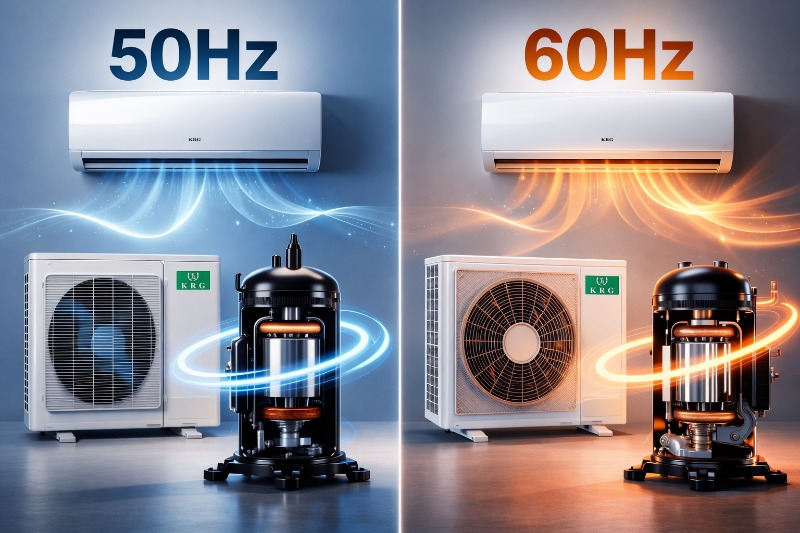
    Actually, Hz (hertz) refers to the frequency of the power grid. Different countries have different frequencies, which directly influence the compressor, motor speed, and the overall performance of the air conditioners. This is very important for air conditioner importers and buyers.


    I. What are 50Hz and 60Hz?


    The frequency of a power grid refers to the number of times the alternating current changes per second.

    50 Hz: It changes 50 times per second;

    60 Hz: It changes 60 times per second.

    Simply, 60Hz current changes faster than 50Hz.


    There are two major power grids in the world:

    50 Hz countries: China, Europe, the Middle East, Africa, Southeast Asia, etc.

    60 Hz countries: America, Canada, Japan, South Korea, the Philippines, part of Saudi Arabia, etc.


    II. Influences on the compressor speed


    Basically, an air conditioner compressor is motor-driven equipment, while the power grid frequency will directly affect the motor speed.

    The theoretical speed formula for an electric motor is: Speed ​​≈ 120 × Frequency ÷ Number of poles. So a 60Hz motor has a speed of 20% more than a 50Hz one.

    An improved motor speed will bring us the improvement of cooling capacity, cooling power, and energy consumption.


    III. Influences on the performance of air conditioner


    1. Cooling capacity


    A same-capacity air conditioner, converting the operation from 50 Hz to 60 Hz, will have its cooling capacity increase about 15%-20%.

    For example, the cooling capacity of a 12000 BTU air conditioner:

    At 50 Hz: around 12000 BTU;

    At 60 Hz: reach 13500-14000 BTU.


    2. Power consumption


    In case of the increase of compressor speed, the power input increases as well as the current.

    So the 60Hz air conditioner normally consumes more electricity during operation.


    3. Noise


    After the increase of compressor and motor speed, the vibration will increase, and the same will happen to the noise.

    But this is not obvious under modern air-conditioner technology.


    IV. Can we use a 50Hz air conditioner in 60Hz countries?


    There are three conditions:


    1. Fixed-frequency air conditioner


    If a 220V 50Hz air conditioner is connected to a 220V 60Hz power grid, it may lead to:

    Overspeed of the compressor;

    Higher current;

    Broken after long-term operation.

    It is not recommended for long-term use.


    2. 60Hz air conditioner used in 50Hz countries


    In the same voltage conditions, 220V 60Hz air conditioners can operate in a 220V 50Hz power grid, but the performance will change. The motor speed will decrease 16%-20%. This decrease may lead to:

    Decrease of compressor speed;

    Decrease of power output;

    Reduced burden on motor.


    3. Variable-frequency air conditioner


    Modern variable-frequency air conditioners (inverter air conditioners) have rectifier and inverter circuits inside the body. It converts alternating current into direct current, then generates a new alternating current frequency by inverter. Many inverter air conditioners can adapt to 50/60Hz.

    That's why many air conditioners are now labeled as 50/60 Hz.


    V. What are the points we should consider when purchasing air conditioners?


    1. Voltage

    110V, 220V, 380V, 440V.


    2. Frequency

    50Hz, 60Hz, or 50/60Hz.


    3. Power supply phase

    1 phase, 2 phases.

    A complete mark normally writes 220–240 V / 1 Ph / 50 Hz.


    The key difference between 50Hz and 60Hz air conditioners lies in the power grid frequency, which directly affects compressor speed and overall performance.

    With the development of inverter technology, more and more air conditioners are adapting to a 50/60 Hz dual-frequency power grid. This makes air conditioners easier to export.
     

  • Why Is The "Invisible Design" More And More of a Concern Among Modern Air Conditioners?

    In the past, people bought air conditioners according to their cooling performance and energy efficiency, but nowadays more and more customers focus on what the machine looks like or even want it invisible after installation. And that's what's currently trending in the air conditioning design field—"invisible design."


    I. What is the "invisible design"?


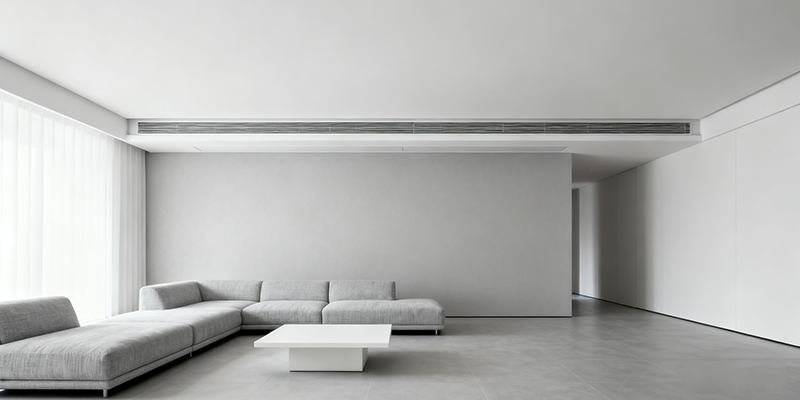
    The so-called "invisible design" is not to make the air conditioner disappear but to naturally combine it with the space by means of design, installation, and structural innovation, making it not the center of vision. Such as:


    · Air outlet combine with the ceiling, like ceiling cassette air conditioners and duct type air conditioners;

    · The thinner and thinner AC body and the more and more narrow frame, like the wall mounted air conditioners;

    · Metal brushed or mirror finish processes are adopted to unify the design with the home style, like floor standing air conditioners;

    · Reduce the presence of the outdoor unit through a hidden grille, noise reduction, and miniaturized design.


    These methods of invisible design are not only an aesthetic change but more of a whole upgrade from function to experience.


    Ceiling concealed air conditioning unit


    II. Why are the "invisible air conditioners" more and more popular?


    1. The awakening of spatial aesthetics


    Minimalism and invisible design are two mainstreams in modern home decor. Customers want every piece of home appliance to have coherence with the overall style, instead of standing out in the way.

    Air conditioners exposed with their body are regarded as a visual burden, particularly in living rooms, open kitchens, and high-end commercial spaces.


    2. Technical progress makes invisibility possible


    Restricted by the compressor size, method of drainage, the control of airflow, and other technologies, the air conditioners in the past could not achieve invisibility. But now, the ultra-slim design, adjustable air deflector, modularized piping, and silent ducting technology make the air conditioners concealed when installed and efficient when operating, achieving "a fading existence but an upgraded comfort."


    3. Upgrading of consumer aesthetics


    The major consuming groups are Generation Z and middle-class families, who focus more on "quality" and "experience." As for them, air conditioning is not just a temperature regulator but more of a consistent part of spatial atmosphere. In case of that, beyond the energy consumption and cooling capacity, what they are also concerned about are:


    · Is its airflow gentle?

    · Does it affect the overall home decor?

    · Can it "exist quietly"?


    4. Visual requirements for commercial spaces


    If the air conditioning equipment is obvious in the room, it will affect the spatial atmosphere in places such as premium hotels, restaurants, KTVs, cinemas, and so on. So the designers prefer the air conditioning solutions that include cassette type and ceiling mounted type air conditioners and linear air outlets to hide inside the buildings. The invisible design had become the fundamental element in high-profile commercial spaces.


    III. Behind the "invisible design" lies a competition of brand technological strength.


    To achieve real invisibility, it's not just an exchange on the outlook but the appearance of ability for the systematic engineering design, including:


    · Precise airflow simulation and static pressure control;

    · Matching with a high-efficiency compressor;

    · Modular structure for easy installation and maintenance;

    · Noise reduction and vibration suppression technology;

    · Integration with an intelligent control system (APP remote control, voice adjustment, seamless start).


    This is an upgrade for the brand from manufacturing- to design-driven.

    For example, brands such as KRG that focus on export markets are gradually introducing product lines such as "ultra-thin ceiling machines" and "hidden duct machines" to meet the hidden needs of different spaces.


    IV. Future Trends: From "Invisible Appearance" to "Invisible Interaction"


    The invisibility of the air conditioner will not only be on the appearance but more on the operation in the future.


    · Automatic balance of temperature and humidity;

    · Human sensing and intelligent wind direction;

    · Integrated voice and App control;

    · Link to home systems seamlessly (such as lighting, curtains, and air quality).


    This means the air conditioner will evolve from an individual appliance to a comfort system with silence, intelligence, and invisibility.


    Invisibility is about to make the air conditioning become a part of life more naturally, not to lose its existence. If the technology and aesthetics combine together, then the visibility of the comfortable airflow experience will be unnecessary, instead of feeling. This is the highest level of modern air conditioning design.