{ Floor Standing Air Conditioner Factory }

  • Forming Challenges of Replacing Copper with Aluminum in Heat Exchangers

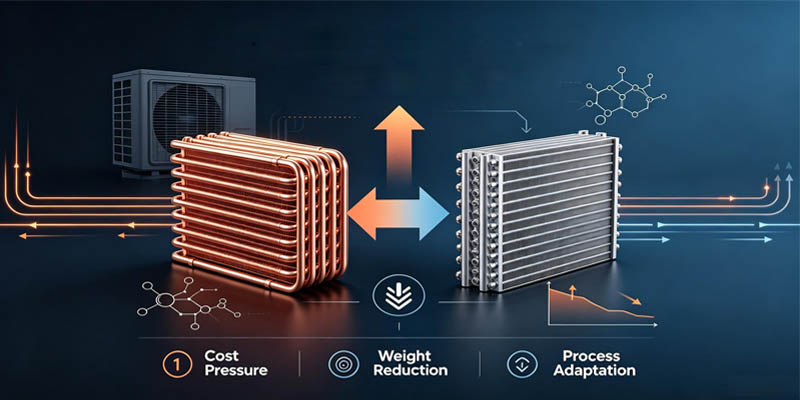
    Why is replacing copper with aluminum gradually a trend in the air conditioning industry?

    In 2026, the price of raw material copper has risen to about 18%, which brought enormous stress to the traditional air conditioner manufacturing regarding copper in the core position.


    Advantages in manufacturing with aluminum materials:


    Lower Raw Material Costs: Copper is significantly more expensive than aluminum. Because raw materials will have a substantial influence on the production cost of an air conditioner, changing to aluminum lets manufacturers protect profit margins. 

    Lighter weight making up for air conditioners: Aluminum weights are far less than copper. It's easier to move, handle, and install air conditioners that are lighter, and they put less stress on buildings and mounting frames. More lightweight air conditioning systems facilitate transportation, handling, and installation while exerting reduced structural strain on structures and mounting brackets.

    Resistance to Formicary Corrosion: Conventional copper piping in air conditioning systems is susceptible to early deterioration due to formicary corrosion (minute pinhole leaks triggered by organic acids and lubricants). Instead, aluminum is naturally resistant to this particular sort of corrosion.

    Innovative Engineering Technology: Modern all-aluminum microchannel heat exchangers use flat tubes with short parallel pathways rather than spherical copper pipes. These designs achieve high heat transfer efficiency while employing less material by weight.


    Difficulty in mechanical forming and processing:


    a) Lack of accurate control of size. When there is bending or stamping, make it much easier to wrinkle, flatten, or produce micro-cracks because of the poor ductility of aluminum.

    b) Cause damage to the structure. Thermal stress, the linear expansion coefficient of aluminum is large, and the thermal expansion and contraction are serious during the alternation of cold and heat, which can easily lead to structural deformation or loose joint surface.

    c) High requirements for micro-channel forming. The porous thin-walled flat tube is extremely dependent on high-precision mold and process control when it is extruded, shaped, and assembled with fins.


    Limits on the welding and connection process


    1. The welding temperature place is quite narrow: Due to the low melting point of the aluminum and the high-level surface oxide film’s melting point, it can easily lead to overburning and collapse of the base metal or cold welding during brazing.

    2. Difficult connection of dissimilar metals: Direct contact between copper and aluminum is easy to cause galvanic corrosion, which requires friction welding, flash butt welding, or special coating, and the process is complex and the defective rate is high.


    Physical and service performance defects compensate for:


    1. Inherently insufficient heat conduction efficiency: the thermal conductivity coefficient is only 60% of that of copper, which needs to be compensated by complex design such as strengthening internal teeth, optimizing fins, or increasing the windward side.

    2. Poor corrosion resistance under harsh working conditions: pitting and perforation are easy to occur in salt spray or industrial environments, so surface treatment processes such as zinc spraying or anticorrosive coating must be added.


    Cost‑saving and lightweight promote copper‑to‑aluminum replacement, while forming and reliability challenges restrict large‑scale popularization. Continuous process optimization is essential for wider industry adoption.
  • What's the Difference Between 50Hz and 60Hz Air Conditioners?

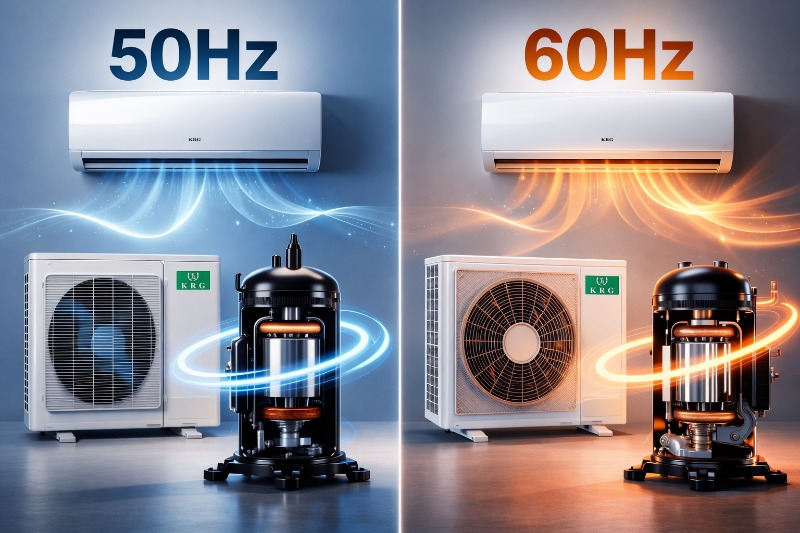
    In the export and international trade of air conditioners, many customers may ask a question: What's the difference between 50 Hz and 60 Hz air conditioners? Are they compatible?

    Actually, Hz (hertz) refers to the frequency of the power grid. Different countries have different frequencies, which directly influence the compressor, motor speed, and the overall performance of the air conditioners. This is very important for air conditioner importers and buyers.


    I. What are 50Hz and 60Hz?


    The frequency of a power grid refers to the number of times the alternating current changes per second.

    50 Hz: It changes 50 times per second;

    60 Hz: It changes 60 times per second.

    Simply, 60Hz current changes faster than 50Hz.


    There are two major power grids in the world:

    50 Hz countries: China, Europe, the Middle East, Africa, Southeast Asia, etc.

    60 Hz countries: America, Canada, Japan, South Korea, the Philippines, part of Saudi Arabia, etc.


    II. Influences on the compressor speed


    Basically, an air conditioner compressor is motor-driven equipment, while the power grid frequency will directly affect the motor speed.

    The theoretical speed formula for an electric motor is: Speed ​​≈ 120 × Frequency ÷ Number of poles. So a 60Hz motor has a speed of 20% more than a 50Hz one.

    An improved motor speed will bring us the improvement of cooling capacity, cooling power, and energy consumption.


    III. Influences on the performance of air conditioner


    1. Cooling capacity


    A same-capacity air conditioner, converting the operation from 50 Hz to 60 Hz, will have its cooling capacity increase about 15%-20%.

    For example, the cooling capacity of a 12000 BTU air conditioner:

    At 50 Hz: around 12000 BTU;

    At 60 Hz: reach 13500-14000 BTU.


    2. Power consumption


    In case of the increase of compressor speed, the power input increases as well as the current.

    So the 60Hz air conditioner normally consumes more electricity during operation.


    3. Noise


    After the increase of compressor and motor speed, the vibration will increase, and the same will happen to the noise.

    But this is not obvious under modern air-conditioner technology.


    IV. Can we use a 50Hz air conditioner in 60Hz countries?


    There are three conditions:


    1. Fixed-frequency air conditioner


    If a 220V 50Hz air conditioner is connected to a 220V 60Hz power grid, it may lead to:

    Overspeed of the compressor;

    Higher current;

    Broken after long-term operation.

    It is not recommended for long-term use.


    2. 60Hz air conditioner used in 50Hz countries


    In the same voltage conditions, 220V 60Hz air conditioners can operate in a 220V 50Hz power grid, but the performance will change. The motor speed will decrease 16%-20%. This decrease may lead to:

    Decrease of compressor speed;

    Decrease of power output;

    Reduced burden on motor.


    3. Variable-frequency air conditioner


    Modern variable-frequency air conditioners (inverter air conditioners) have rectifier and inverter circuits inside the body. It converts alternating current into direct current, then generates a new alternating current frequency by inverter. Many inverter air conditioners can adapt to 50/60Hz.

    That's why many air conditioners are now labeled as 50/60 Hz.


    V. What are the points we should consider when purchasing air conditioners?


    1. Voltage

    110V, 220V, 380V, 440V.


    2. Frequency

    50Hz, 60Hz, or 50/60Hz.


    3. Power supply phase

    1 phase, 2 phases.

    A complete mark normally writes 220–240 V / 1 Ph / 50 Hz.


    The key difference between 50Hz and 60Hz air conditioners lies in the power grid frequency, which directly affects compressor speed and overall performance.

    With the development of inverter technology, more and more air conditioners are adapting to a 50/60 Hz dual-frequency power grid. This makes air conditioners easier to export.