{ Ceiling Cassette Air Conditioner Supplier }

  • Forming Challenges of Replacing Copper with Aluminum in Heat Exchangers

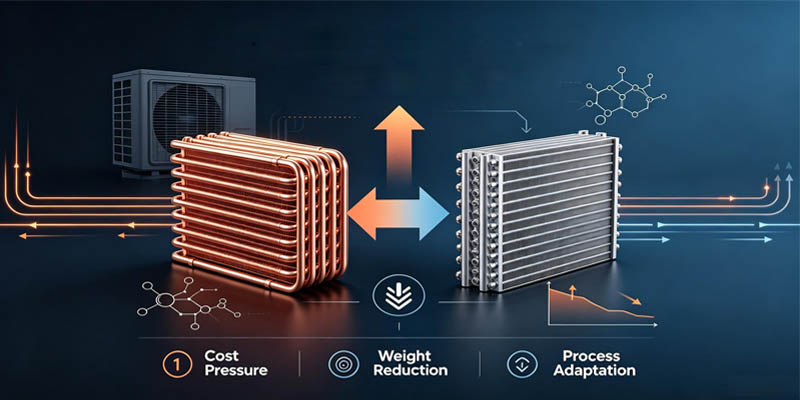
    Why is replacing copper with aluminum gradually a trend in the air conditioning industry?

    In 2026, the price of raw material copper has risen to about 18%, which brought enormous stress to the traditional air conditioner manufacturing regarding copper in the core position.


    Advantages in manufacturing with aluminum materials:


    Lower Raw Material Costs: Copper is significantly more expensive than aluminum. Because raw materials will have a substantial influence on the production cost of an air conditioner, changing to aluminum lets manufacturers protect profit margins. 

    Lighter weight making up for air conditioners: Aluminum weights are far less than copper. It's easier to move, handle, and install air conditioners that are lighter, and they put less stress on buildings and mounting frames. More lightweight air conditioning systems facilitate transportation, handling, and installation while exerting reduced structural strain on structures and mounting brackets.

    Resistance to Formicary Corrosion: Conventional copper piping in air conditioning systems is susceptible to early deterioration due to formicary corrosion (minute pinhole leaks triggered by organic acids and lubricants). Instead, aluminum is naturally resistant to this particular sort of corrosion.

    Innovative Engineering Technology: Modern all-aluminum microchannel heat exchangers use flat tubes with short parallel pathways rather than spherical copper pipes. These designs achieve high heat transfer efficiency while employing less material by weight.


    Difficulty in mechanical forming and processing:


    a) Lack of accurate control of size. When there is bending or stamping, make it much easier to wrinkle, flatten, or produce micro-cracks because of the poor ductility of aluminum.

    b) Cause damage to the structure. Thermal stress, the linear expansion coefficient of aluminum is large, and the thermal expansion and contraction are serious during the alternation of cold and heat, which can easily lead to structural deformation or loose joint surface.

    c) High requirements for micro-channel forming. The porous thin-walled flat tube is extremely dependent on high-precision mold and process control when it is extruded, shaped, and assembled with fins.


    Limits on the welding and connection process


    1. The welding temperature place is quite narrow: Due to the low melting point of the aluminum and the high-level surface oxide film’s melting point, it can easily lead to overburning and collapse of the base metal or cold welding during brazing.

    2. Difficult connection of dissimilar metals: Direct contact between copper and aluminum is easy to cause galvanic corrosion, which requires friction welding, flash butt welding, or special coating, and the process is complex and the defective rate is high.


    Physical and service performance defects compensate for:


    1. Inherently insufficient heat conduction efficiency: the thermal conductivity coefficient is only 60% of that of copper, which needs to be compensated by complex design such as strengthening internal teeth, optimizing fins, or increasing the windward side.

    2. Poor corrosion resistance under harsh working conditions: pitting and perforation are easy to occur in salt spray or industrial environments, so surface treatment processes such as zinc spraying or anticorrosive coating must be added.


    Cost‑saving and lightweight promote copper‑to‑aluminum replacement, while forming and reliability challenges restrict large‑scale popularization. Continuous process optimization is essential for wider industry adoption.

  • Global Air Conditioner Manufacturers Industry Landscape and Future Trends

    The air conditioning industry is undergoing an unprecedented development opportunity under the background of global climate change and the acceleration of urbanization. From traditional residential air conditioners to industrial cooling systems and the combination of intellectualization and energy-saving technologies, air conditioner manufacturers are now rebuilding the market landscape continuously.


    I. Overview of the global air conditioning industry


    Currently, the global air conditioning market is dominated by three major areas: Asia, Europe, and North America. In which the manufacturers from China, Japan, and South Korea have obvious advantages in production scale and the integration of supply chains, while European companies occupy the main position in high-end technology and brand reputation.

    With the swift increase of demand among emerging markets (such as Southeast Asia, India, the Middle East, and Africa), the air conditioners are converting from "luxury products" into "basic life necessities." This pushes the global manufacturers to expand production capacity continuously and optimize the product structure.


    II. Types of major air conditioner manufacturers


    1. Comprehensive home appliance giant

    This type of enterprise is normally equipped with complete production lines, ranging from residential air conditioners to commercial central air conditioning systems, obtaining powerful R&D capability and global channel networks.


    2. Professional HVAC companies

    They concern industrial and commercial fields, playing an important role in large building, data center, and fundamental equipment construction.


    3. Emerging technology-driven companies

    They stress intellectualization, the internet of things (IoT), and energy efficiency, improving users' experience through software and hardware.


    residential air conditioners


    III. Technical improvement trend


    1. Energy-saving and environmental protection

    With the progression of global carbon peak orientation, the industry is moving toward a destination with higher efficiency air conditioners and more eco-friendly refrigerants.


    2. Intellectualization and IoT

    Intelligent air conditioners can achieve remote control through mobile apps and adjust the operation automatically according to the environment.


    3. Modularization and customization

    The manufacturers provide more flexible solutions according to different scenarios, such as hospitals, data centers, and industrial workshops.


    IV. Supply chain and market competition


    In recent years, the raw material price fluctuations and global logistics challenges put stress on air conditioner manufacturers. They start to strengthen the localized production landscape to reduce risks in the supply chain. Meanwhile, competition between brands converts from price to technical and service abilities.


    V. How does KRG behave in the industry?


    Among those participants, KRG air conditioning gradually becomes an emerging power that is worth concern. In the integration of supply chain and zoning-market expansion, KRG behaved with stronger flexibility. Particularly in the middle-class market and customization field, KRG has advantages in the competition.


    Through strengthened quality control and cost-optimizing strategies, KRG had found itself in the fierce competitions. At the same time, the company is gradually laying out intellectualized technology to improve the additional product value and customers' experience.


    There are distances between KRG and the leading companies, but their development paths demonstrate a classic growth pattern of emerging manufacturers in the global air conditioning industry.


    VI. The future trend


    The global air conditioner manufacturing industry is now on a vital stage of conversion and upgrading. From traditional production to intellectual manufacturing, and from a single product to systematic solutions, every company is seeking a point of growth. No matter if it is the industrial giant or an emerging power like KRG, we are all playing an important role in the process.


    In the coming years, the air conditioning industry is moving forward in the following directions:

    Higher utilization efficiency of energy;

    Smarter intercommunication among users;

    More eco-environmentally manufacturing and the materials;

    More flexible global supply chain.


    As for the air conditioner manufacturers, only balancing the technical innovation, cost control, and market insight will let us stand out in the global competition.