{ Ceiling Cassette Air Conditioner }

  • How to Select Air Conditioner for Hotel and Apartment Projects?

    In real estate projects like hotels and apartments, an air conditioning system not only influences the comfort of guests but also relates to the cost of investment and operation and the maintenance efficiency. For the building developers and project contractors, choosing a proper air conditioning system is a technical decision that requires comprehensive consideration.

    This article will analyze the key factors that need to be considered when choosing air conditioning equipment for hotels and apartments from the perspective of practical engineering applications.


    I. Confirm the type of project: hotel or apartment


    Though the hotels and apartments have similarity in building structure, the utilizing modes are obviously different.

    Hotel project features:

    Frequent use of rooms with high turnover;

    High pursuit for comfort;

    Centralized management of appliances at front desk or backstage;

    Long-period operation of air conditioners.


    Apartment project features:

    Fixed users;

    Concerning on unit price and maintenance cost;

    Individually controled air conditioners;

    Less demand for centralized management.
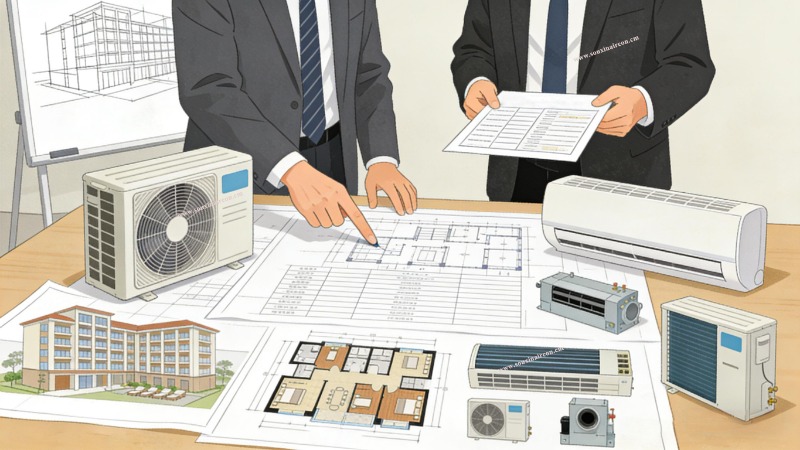


    II. Common air conditioning systems


    1. Split air conditioning system


    The split system is one of the most widespread air conditioning systems, particularly in small and medium hotels and apartments.

    They have advantages including a small initial investment, simple installation, easy maintenance, and individual unit control.

    But if the amount increases, there will be many outdoor units hanging outside of the building, which brings difficulty for the management of the exterior wall.

    They are suitable for economic hotels, apartments, and renovation projects.


    2. VRF/VRV


    Variable refrigerant flow (VRF) or variable refrigerant volume (VRV) systems are more and more popular among middle- and high-class hotels and service-driven apartments.

    They can connect multiple indoor units to one outdoor unit with a high EER, enabling central management.

    But the initial cost for the system is high, and the installation and design are complex, which requires high-quality installation.

    They are usually adopted by 4-star and above hotels, service-driven apartments, and middle- and high-class commercial residential projects.


    3. Ducted air conditioning system


    Duct air conditioners are common solutions for many hotel projects, with both cost-effectiveness and beauty.

    They can hide inside the ceiling with high aesthetics, even airflow, and considerate comfort and a lower cost than a VRF system.

    But still, each room needs a system individually, and the maintenance will destroy the ceiling, which brings cost and complexity.

    They are suitable for commercial hotels, middle- and high-class apartments, and long-term rental apartments.


    III. Factors needs to consider when selection


    1. initial cost


    It includes the unit cost of air conditioners, installation costs, and the consumed material cost.


    2. Energy efficiency


    The air conditioning system is the most energy-consuming equipment in hotel buildings. High-efficiency air conditioners can obviously reduce operation costs in the long term.


    3. Maintenance and aftersales


    Hotel projects normally own dozens or hundreds of rooms, so the maintenance flexibility is very important.


    4. Building facade management


    If each room owns an individual air conditioning system, there will be too many outdoor units outside of the wall. Then the appearance of the building is a bit messy, and the noise is also a problem.

    In that case, many newly built hotels tend to use VRF systems and centralized air conditioning systems.


    5. Climate conditions


    Different countries, different climates, different air conditioner selections.

    Middle East: Requires air conditioning for high-temperature operation.

    Southeast Asia: Dehumidification is important.

    Europe: Greater emphasis on energy efficiency and environmental protection.


    It's not just a matter of unit price but a comprehensive consideration among initial cost, energy efficiency, installation, maintenance, and building design. A proper air conditioning system not only improves customer experience but also reduces the long-term operation cost. For developers and engineering procurements, a reasonable air conditioning system will significantly increase the overall value of the project.
  • What's the Difference Between 50Hz and 60Hz Air Conditioners?

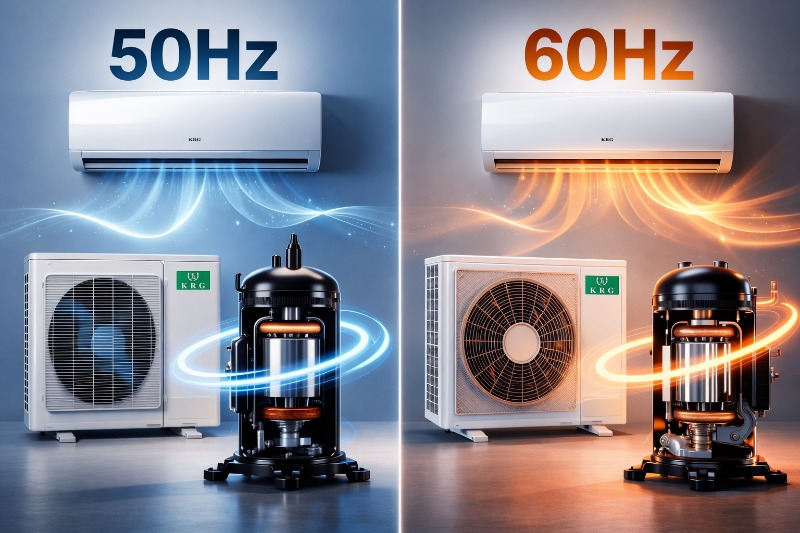
    In the export and international trade of air conditioners, many customers may ask a question: What's the difference between 50 Hz and 60 Hz air conditioners? Are they compatible?

    Actually, Hz (hertz) refers to the frequency of the power grid. Different countries have different frequencies, which directly influence the compressor, motor speed, and the overall performance of the air conditioners. This is very important for air conditioner importers and buyers.


    I. What are 50Hz and 60Hz?


    The frequency of a power grid refers to the number of times the alternating current changes per second.

    50 Hz: It changes 50 times per second;

    60 Hz: It changes 60 times per second.

    Simply, 60Hz current changes faster than 50Hz.


    There are two major power grids in the world:

    50 Hz countries: China, Europe, the Middle East, Africa, Southeast Asia, etc.

    60 Hz countries: America, Canada, Japan, South Korea, the Philippines, part of Saudi Arabia, etc.


    II. Influences on the compressor speed


    Basically, an air conditioner compressor is motor-driven equipment, while the power grid frequency will directly affect the motor speed.

    The theoretical speed formula for an electric motor is: Speed ​​≈ 120 × Frequency ÷ Number of poles. So a 60Hz motor has a speed of 20% more than a 50Hz one.

    An improved motor speed will bring us the improvement of cooling capacity, cooling power, and energy consumption.


    III. Influences on the performance of air conditioner


    1. Cooling capacity


    A same-capacity air conditioner, converting the operation from 50 Hz to 60 Hz, will have its cooling capacity increase about 15%-20%.

    For example, the cooling capacity of a 12000 BTU air conditioner:

    At 50 Hz: around 12000 BTU;

    At 60 Hz: reach 13500-14000 BTU.


    2. Power consumption


    In case of the increase of compressor speed, the power input increases as well as the current.

    So the 60Hz air conditioner normally consumes more electricity during operation.


    3. Noise


    After the increase of compressor and motor speed, the vibration will increase, and the same will happen to the noise.

    But this is not obvious under modern air-conditioner technology.


    IV. Can we use a 50Hz air conditioner in 60Hz countries?


    There are three conditions:


    1. Fixed-frequency air conditioner


    If a 220V 50Hz air conditioner is connected to a 220V 60Hz power grid, it may lead to:

    Overspeed of the compressor;

    Higher current;

    Broken after long-term operation.

    It is not recommended for long-term use.


    2. 60Hz air conditioner used in 50Hz countries


    In the same voltage conditions, 220V 60Hz air conditioners can operate in a 220V 50Hz power grid, but the performance will change. The motor speed will decrease 16%-20%. This decrease may lead to:

    Decrease of compressor speed;

    Decrease of power output;

    Reduced burden on motor.


    3. Variable-frequency air conditioner


    Modern variable-frequency air conditioners (inverter air conditioners) have rectifier and inverter circuits inside the body. It converts alternating current into direct current, then generates a new alternating current frequency by inverter. Many inverter air conditioners can adapt to 50/60Hz.

    That's why many air conditioners are now labeled as 50/60 Hz.


    V. What are the points we should consider when purchasing air conditioners?


    1. Voltage

    110V, 220V, 380V, 440V.


    2. Frequency

    50Hz, 60Hz, or 50/60Hz.


    3. Power supply phase

    1 phase, 2 phases.

    A complete mark normally writes 220–240 V / 1 Ph / 50 Hz.


    The key difference between 50Hz and 60Hz air conditioners lies in the power grid frequency, which directly affects compressor speed and overall performance.

    With the development of inverter technology, more and more air conditioners are adapting to a 50/60 Hz dual-frequency power grid. This makes air conditioners easier to export.


  • How Does the Climate Conditions Affect the Air Conditioning Performance?

    During the selection and use of air conditioners, most people only concern themselves with the cooling capacity, energy efficiency, and the brand but omit a key factor—the climate conditions. Actually, temperature, humidity, altitude, and even the dusty environment will transparently influence the cooling performance, energy efficiency, and lifespan of air conditioners. As for the air conditioner importers, engineering contractors, and large project purchasers, understanding the relationship between the climate and the air conditioner performance is the vital basis for choosing proper equipment.


    I. High-temperature environment—the cooling ability may decreased


    In hot areas, such as the Middle East, Africa, or South Asia, the temperature in summer normally exceeds 45℃. Under such conditions, the outdoor unit needs to bring heat from indoors to a hotter outside, which apparently lowers the heat exchange efficiency.

    The influences mainly include:


    Decreased cooling ability: The higher the ambient temperature, the more burden the compressor loads.

    Increased energy consumption: The air conditioner will take more time to reach the set temperature.

    Increased compressing pressure: Long-term operation under such conditions may shorten the lifespan of the equipment.


    In case of that, for the high-temperature regions, many engineering projects will choose T3 air conditioners with resistance to high temperatures (about 52℃). These air conditioners have larger condensers with a wider heat-exchange area and higher-performance compressors. That's why the same 18000BTU split air conditioner in a tropical region will have a higher standard with higher cooling performance as well as a higher unit price.


    II. High-humidity environment:  it increases dehumidification burden


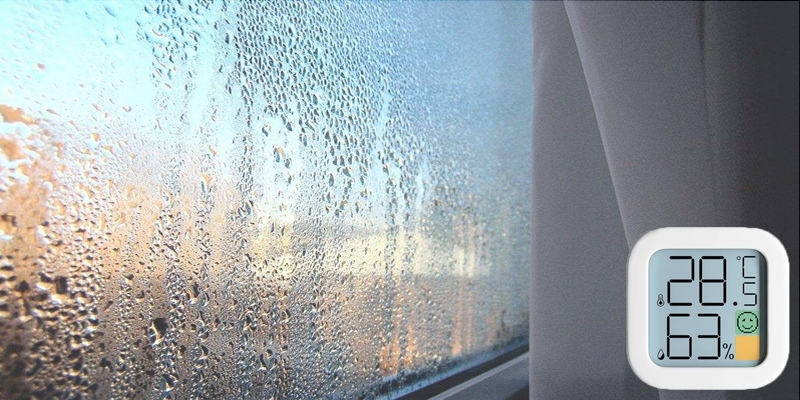
    In Southeast Asia, South America, and coastal regions, high humidity is common there. The air conditioners will cool the air temperature and dehumidify the air.

    Influences of humidity on air conditioners include the following:


    Increased burden for cooling: The air conditioners shall deal with visible heat and potential heat.

    Dehumidity ability is needed: The evaporator needs to be designed for higher efficiency.

    More condensate: The drainage system needs to be more reasonable.


    If the air conditioner has poor dehumidity ability, the users will feel muggy, sticky, and uncomfortable even if the temperature is not high. So the size of the evaporator and the design of airflow are important for high-humidity areas. Our KRG split air conditioners have dehumidification mode in all capacities; please inquire with us for more details.


    III. Low-temperature environment: it influences heating and defrosting


    In cold areas, air conditioners will face challenges when using a heat pump for heating due to the frosted outdoor unit.

    When the outside temperature is low and the humidity is high:


    The surface temperature of the outdoor unit heat-exchanger is lower than 0 ℃.

    The steam in the air will frost on the heat exchanger.

    The frost will affect the heat-exchange efficiency.


    At this moment, the air conditioner will defrost automatically:


    Stop heating temporarily.

    Reverse to operate heating to defrost.

    Back to normal heating


    If the control of defrosting is unstable, then:


    The indoor temperature will fluctuate.

    The heating efficiency will decrease.

    The energy consumption will increase.


    IV. Dusty and extreme environments


    In parts of the desert or dusty areas, air conditioners need to face the dust pollution problem.

    The dust will lead to problems below:


    Blockade on condenser,

    Decreased efficiency on heat exchanger,

    Increased load on the fan motor.


    To solve these issues, we can:


    Densify the fin structure of the condenser,

    Paint an anti-rust coating.

    Change designs into portable and washable parts.


    We are a professional air conditioner manufacturer; we can customize the product according to the client's specifications.


    V. High-altitude environment: the air density is low


    In high-altitude areas (such as parts of South America, Africa, and Central Asia), the air density is low, which also influences the air conditioning system.

    This will mainly influence:


    Lower heat-exchange efficiency on condenser,

    Higher discharge temperature on compressor,

    Lower working efficiency on the fan motor.


    Normally, the air conditioning efficiency will start to decrease when the altitude exceeds 1000 meters. Under such circumstances, we may need to change a larger condenser and increase the size or heating capacity of the equipment.


    Air conditioners are not a "globally standardized" product. The climate conditions directly determine the design, configuration, and performance of the air conditioning system. When we are selecting air conditioners for projects or purchasing wholesale, we must consider the local climate environment besides the price and brand. Only the products that suit the local climate conditions shall truly achieve a better cooling experience, lower operation cost, and longer lifespan.


  • What Do Conditioner Importers Concern Most When Purchasing?

    In the global trade of air conditioners, buyers normally care about not only the price but also the suppliers and products when they are selecting them.

    For the air conditioner distributors and branding sellers, their concerns are whether the product suits the market stably and reliably and if the cooperation is continuous.

    So, what do conditioner importers concern most when purchasing? Knowing the points will not only help the suppliers treat clients well but also help buyers to make reasonable decisions when purchasing.


    I. Quality and reliability


    For the importers, product quality is the most important key point. As the air conditioners are durable consumer goods, once the quality issue happens, then the after-sales service will cost and may even influence the brand's frame. So importers normally place deep concerns on the following:


    Compressor brand and reliability,

    Key components (electric control, fan motor, capacitor, etc.),

    Lifespan and stability,

    Systematic quality control of the factory.


    Many buyers will ask for test reports and certificates from the suppliers. Stable quality is more attractive than a lower price.


    II. Whether the product comply with the local certifications


    Different countries and regions have different regulations and certification requirements. Such as CE (European market), SASO (KSA market), GCC (Gulf countries), CCC (China), ERP (Europe), etc.

    If the product is not certified accordingly, importers normally cannot complete the custom clearance and distribute it. So many importers will ask in advance:


    Whether the product complies with local certifications,

    Whether the product comply with the local voltage and frequency,

    What's the energy efficiency class?


    Suppliers with a complete certification system will more easily gain long-term cooperation opportunities.


    III. Price and market competitiveness


    Unit price is absolutely a key factor when purchasing, but importers normally concern themselves with market competitiveness instead of the lowest price.

    They will check comprehensively:


    The purchasing price,

    Shipping and logistics costs,

    Import tax,

    Retail price and profit.


    If the product has a stable quality and a reasonable price, the importers will build long-term resale channels in the local market more easily.


    IV. Whether the production line is complete


    Many importers want the supplier to provide the whole product series instead of a single model. Such as air conditioner capacities from 9000 BTU to 36000 BTU. Various markets need various models, such as inverter air conditioners (or non-inverter air conditioners), cooling-only air conditioners (or cooling heating), split air conditioners, floor standing airs, etc.


    The more complete the production line, the easier it is for the importer to build unit branding and a stable supply in the market.


    V. Delivery capability and supply stability


    As for the importers, stable supply is essential as well. If the supplier cannot deliver the goods timely, it will lead to the following:


    Lack of stock in peak season,

    Tense relationship with distributors,

    Decrease of market share.


    In case of that, buyers will evaluate the suppliers on production capability, lead time, peak-season capacity, and raw-material supply stability. A stable supply chain is the vital basis of long-term cooperation.


    VI. After-sales support and spare parts supply


    There are unavoidable maintenance demands during the use of air conditioners, so after-sales support is also important.

    Buyers are also concerned with the following:


    Whether the spare parts supply is supported,

    Whether technical guidance provided,

    Whether the technical datasheet is offered,

    Whether there is remote technical support.


    A good after-sales system will help importers reduce maintenance costs and improve the end user's satisfaction.


    VII. Cooperation modes and branding strategies


    Different importers have different business modes, so the cooperation modes are different as well.

    Common cooperation modes are as follows:


    OEM production (using importers' brand),

    ODM (products designed by importers),

    Branding distributorship (deal as an agent of the supplier's brand).


    At the initial stage, both parties will negotiate the following:


    Whether there are market protection,

    Whether there are marketing support,

    Whether the brand is allowed to customize.


    A reasonable cooperation mode will contribute to building a long-term and stable business relationship between both parties.


    We are a professional air conditioner manufacturer in China. Should you have any other questions in the industry, please don't hesitate to reach us!

  • What Is "Thermal Inertia"? Why Is It Harder to Cool Down A Larger House?

    Most of us have the experience that a small room could be cooled down in several minutes, but for a larger space, the temperature decreases slowly even though the air conditioner has been operating for a long time. It doesn't mean the air conditioner has not enough cooling ability; instead, a most important physical concept contributed to the situation—thermal inertia, which is often being omitted.


    I. What's thermal inertia?


    Thermal inertia is the insensitivity level of an object or space to the temperature exchanges. Simply, it means the higher the thermal inertia, the slower the temperature exchanges; and the lower the thermal inertia, the faster the temperature exchanges.


    It is not simple data, which is determined by three factors: mass, specific heat capacity, and the heat exchange conditions.

    Inside the buildings and rooms, the thermal inertia performs mainly in walls, ceilings, floors, appliances, and the air itself. All those items will store heat.


    II. Why does a larger house have a higher thermal inertia?


    1. More items which store heat in the house


    The larger house has wider wall areas, larger air volume, more concrete and bricks used in construction, and more space to put appliances and decorations. These are all heat storages. When the outside temperature is high, those heat storages have absorbed much heat already.


    2. Air conditioning is to remove heat first, not to lower the temperature


    The core task of air conditioners is not to blow cold air but to remove the heat from indoors to the outdoors steadily.

    In large spaces, the air conditioner needs to remove heat from walls, floors, appliances, and the air steadily. The larger the space, the more heat needed to be removed, so it took a longer time.


    3. The surface temperature determines the body temperature


    Though the temperature had been cooled down, if the wall is hot, the floor is hot, and the appliance surface is hot, according to reflection heat transfer, the human body will feel its heat as well.

    That's why people still don't feel cool even though the temperature already shows 24℃ in the large house. Thermal inertia makes it much slower for people to get "real coolness."


    III. Why it may not necessarily solve the issue by purchasing a larger capacity cooling device?


    Most people will choose a larger capacity air conditioner to cool a large house, such as a floor standing air conditioner or a cassette air conditioner. But the common questions are unreasonable gas-liquid distribution, cold air cannot reach the areas with heat burden, unreasonable air-return design, and long-term stays of heat in a partial area. As a result, the energy consumption rises, but the comfort has no significant improvement.


    IV. For cooling in the large spaces, the key is to deal with the thermal inertia


    1. Start the air conditioner in advance, rather than operating it when it's hot

    2. Focus on the airflow coverage, rather than the cooling capacity

    3. Zoning control, separately dealing with the thermal inertia

    4. Matching the air conditioning systematically rather than focusing on the unit datas


    In large houses, villas, and commercial spaces, VRF, ducted air conditioners, and joint-combined systems are more suitable in both comfort and energy savings.


    In the large houses, it's not harder to blow cold air but to remove more heat, which is the thermal inertia that influences it. What determines the comfort is not only how big the air conditioner is, but also whether the whole system is recognized and allowed to operate by following the physical rules.