{ Air Source Heat Pump }

  • Air Source Heat Pumps What Exactly Are They?

    With the continuous energy cost and increasing market demand for energy-saving, eco-friendly heating equipment, air source heat pumps are becoming a popular new heating solution.


    So what exactly is an air-source heat pump? Why is it able to replace some traditional heating equipment?


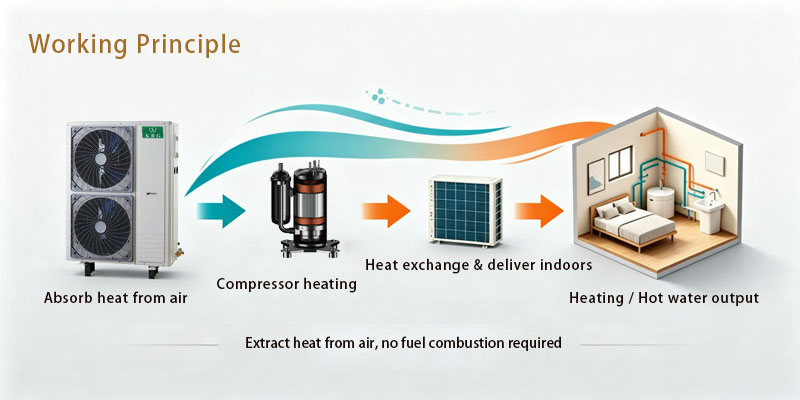
    Simply put, an air-source heat pump draws heat from outdoor air to heat rooms and supply hot water. It does not create heat by burning gas or other fuels. Instead, it uses heat pump technology to collect heat from the air and move it indoors.


    How Do Air Source Heat Pumps Work?


    So, you’ve probably heard about air source heat pumps, but how do they actually work? Well, they operate pretty much like the opposite of your air conditioner, and it’s kinda cool when you think about it.


    Here’s the deal: these units pull in heat from the air outside, even when it’s chilly. Yep, there’s still heat out there, just waiting to be used! The outdoor part of the pump absorbs this heat, and then the compressor kicks in, heating it up even more.


    Once the heat is nice and toasty, it gets pushed into your home through a heat exchange system. This means you can use it for:


    • Room heating;
    • Floor heating system;
    • Radiator heating;
    • Domestic hot water supply.


    What’s great about air source heat pumps is that they mostly run on electricity. They’re not burning fuel to make heat, which makes them more energy-efficient.


    Why are more and more people choosing air-source heat pumps?


    Heat pumps can be used in far more scenarios than standard gas boilers and electric heating units.

    What’s neat about these heat pumps is that they don’t burn fuel. That makes them safer and better for our planet. They actually grab heat right out of the air, which can help you cut down on those energy bills.

    And if you live in a colder place, low-temperature air-source heat pumps are a game changer. They’re made to work even when it’s freezing outside. So, no matter what the weather is doing, they keep you warm and cozy all winter.


    Where Can Air Source Heat Pumps Be Used?


    Air-source heat pumps are now installed in many kinds of buildings, including:


    • Residential buildings;
    • Villas & apartment blocks;
    • Hotels and other commercial premises;
    • Schools and civic amenities;
    • Hot water supply systems for industrial and agricultural use.


    These systems provide consistent, high-performance heating in winter and dependable hot water all year round.


    An air-source heat pump is not merely a "heating device" but an efficient energy system that utilizes renewable thermal energy from the air.

    With the growing global focus on energy conservation, environmental protection, and energy efficiency, air-source heat pump units are becoming an important development direction for future building heating and hot water supply.


  • Can an Air Conditioner Operate Under -40℃?

    To those living in extremely cold regions, a common question comes when it is needed to heat by an air conditioner in winter: can the air conditioner outdoor unit operate freely in an extremely cold environment or not? Particularly under the ultra-low temperatures of -30℃ and -40℃, is the air conditioner able to supply reliable heat?


    1. What are the limits of traditional air conditioners?


    Traditional non-inverter or inverter air conditioners are available to operate under the ambient temperature of -7℃ to -15℃. When the temperature goes further lower, the situations below will occur:


    i). Apparent decrease of heating capacity;

    ii). Severe frost on the outdoor unit and defrosting affect heating performance.

    iii). The compressor is hard to start or does not even start.


    In case of that, traditional air conditioners can not start freely under the temperature of -30℃ and even -40℃.


    2. Advanced technology: EVI technology


    For cold regions, air conditioner manufacturers will develop the air conditioner models with EVI (Enhanced Vapor Injection) technology. By adding additional jet ports for gas in the compressor, the technology allows the refrigerant to keep enough pressure and flow under the extreme cold condition, improving the heating ability under low temperature. Adopted with EVI technology, the air conditioners could provide stable heating under -25℃ to -30℃ environments. Some high-end models are claimed to start freely under -35℃.


    3. Impossibility under -40℃


    Under a -40℃ environment, even the high-end air conditioning models are still facing great challenges:


    i). The starting difficulty: Thickening of the refrigerant oil makes it difficult to lubricate the compressor.

    ii). The decreasing heating capacity: Even if the system can start, the heating capacity will be significantly reduced.

    iii). The increasing power consumption: Even if the system can start, the heating capacity will be significantly reduced.


    Common solutions to the -40℃ environments are ultra-low temperature air source heat pumps (customized commercial/engineering machines), rather than ordinary household air conditioners, or electric auxiliary heating and gas heating with air conditioning used in conjunction.


    4. Options for the cold areas.


    For regions in the Mongolia plateau, Northern Russia, and Canada, it is recommended to choose low-temperature heat pump air conditioners with EVI technology or directly choose air source heat pump heating units, whose operating limit can be extended to -35℃ or even -40℃, or combine them with backup heating methods such as floor heating and electric heaters to ensure comfort and safety in extreme weather.


    Traditional air conditioners can't start at -40°C. Even some high-end low-temperature heat pump models claim to be able to operate, but they require extremely demanding technical support and operating environments. For users in extremely cold regions, choosing a professional ultra-low-temperature heat pump product is the only reliable way to heat your home in winter.