{ China Air Conditioner Price }

  • Does the Set Temperature Equal the Actual Indoor Temperature?

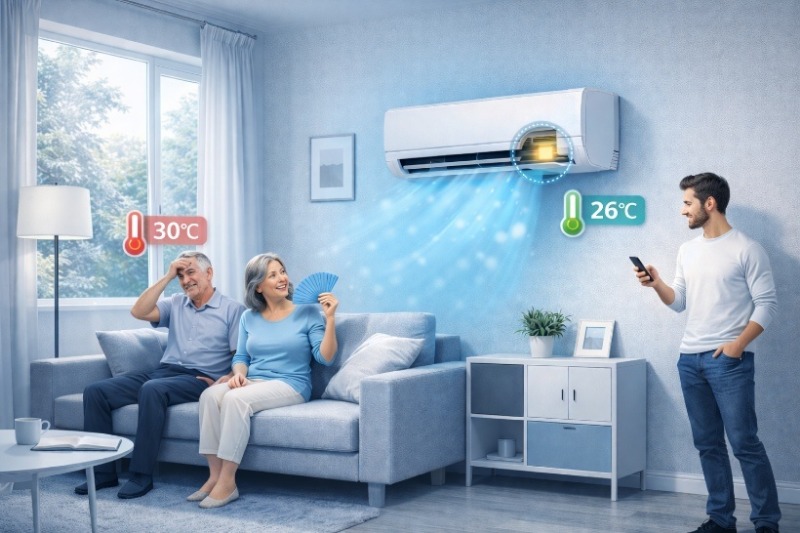
    Many people have the experience when using the air conditioner that we set a temperature at 26℃, but the room temperature is still not comfortable. Is that the error of the sensor or the air conditioner itself?

    The answer is that when the air conditioner is set to a temperature, it does not mean the temperature at every corner of the room. We are going to explain it clearly based on its mechanism.


    I. What exactly does the "set temperature" of an air conditioner measure?


    The air conditioner does not measure the whole room temperature, but it determines whether it needs continuous cool or heat by the sensor.

    In most of the wall mounted air conditioners or floor standing air conditioners, the temperature sensor is normally located near the air inlet of the indoor unit or inside the air inlet zone, which measures the air temperature near the air conditioner. This means that whether the air is conditioned to 26℃ or not depends not on the position where you are but on the area around the air conditioner.


    wall mounted air conditioners


    II. Why are there different temperatures in the same room at the same time?


    The temperature is not completely uniform even in the same room. There are factors that influence it: 


    1. Air stratification


    The cold air has high density, which tends to sink, while the hot air has a low density and tends to rise. As a result, the space that is close to the ground is colder, and the space that is close to the ceiling is hotter. That's why some feel cold on the feet and hot on the head and feel uncomfortable. With an air conditioner operating, people still feel uncomfortable.


    2. Building structure and insulation conditions


    West-facing walls, glass windows → continuous heat taken in

    Wide room space, high floor height → stronger thermal inertia

    Leakage in door gaps and window gaps → Continuous coolness loss

    All these will mislead the air conditioner to regard the cooling procedure as having reached the setting temperature, but the whole room is not truly stable.


    3. The relation between airflow and the human body position


    Direct air blow → More cooling;

    Back-wind zone or corners → Higher temperature;

    At the same 26℃, people sitting beneath the air outlet will feel cold, while those sitting at the corner will feel hot.


    III. Why is 26°C sometimes still cold?


    This is a common misconception among many people. Actually, the air conditioner is working between a temperature range instead of pursuing 26℃.

    For example, the setting temperature is 26℃, but the actual control range is 25℃ to 27℃. When the sensor detects the temperature lower than the limit (here 25℃), the compressor will slow its speed or stop working; when higher than the limit (here 27℃), the compressor will start to work again.

    If at this time, you sit near the direct air blow area or around the sensor, you will feel colder but with a not-so-low temperature setting.


    IV. Why do the inverter air conditioners seem more stable?


    Compared with normal non-inverter air conditioners, the advantages of the inverter air conditioners lie in the following facts:


    · The compressor speed is continuously adjustable;

    · The temperature fluctuation is lower;

    · The indoor airflow is more smooth and comfortable;


    This doesn't mean the inverter air conditioners measure the temperature more precisely, but when the air reaches the setting temperature, it works at a low power continuously instead of stopping working. Finally the indoor temperature becomes more uniform, and the experience of the human body is more comfortable.


    V. How to adjust the room temperature more reasonably?


    Instead of struggling over whether the temperature is precisely measured or not, we'd better focus on the comfort and the power consumption.


    Common advice:

    · Summer cooling temperature: 26-28℃;

    · Adopt with wind speed adjustment instead of lowering the temperature blindly;

    · Avoid long-time direct air blow;

    · Slightly close the window, curtains, and doors when there is poor tightness in the room;


    Noted: The air conditioner is to remove excessive heat, not to "create low temperature".

  • What Is "Thermal Inertia"? Why Is It Harder to Cool Down A Larger House?

    Most of us have the experience that a small room could be cooled down in several minutes, but for a larger space, the temperature decreases slowly even though the air conditioner has been operating for a long time. It doesn't mean the air conditioner has not enough cooling ability; instead, a most important physical concept contributed to the situation—thermal inertia, which is often being omitted.


    I. What's thermal inertia?


    Thermal inertia is the insensitivity level of an object or space to the temperature exchanges. Simply, it means the higher the thermal inertia, the slower the temperature exchanges; and the lower the thermal inertia, the faster the temperature exchanges.


    It is not simple data, which is determined by three factors: mass, specific heat capacity, and the heat exchange conditions.

    Inside the buildings and rooms, the thermal inertia performs mainly in walls, ceilings, floors, appliances, and the air itself. All those items will store heat.


    II. Why does a larger house have a higher thermal inertia?


    1. More items which store heat in the house


    The larger house has wider wall areas, larger air volume, more concrete and bricks used in construction, and more space to put appliances and decorations. These are all heat storages. When the outside temperature is high, those heat storages have absorbed much heat already.


    2. Air conditioning is to remove heat first, not to lower the temperature


    The core task of air conditioners is not to blow cold air but to remove the heat from indoors to the outdoors steadily.

    In large spaces, the air conditioner needs to remove heat from walls, floors, appliances, and the air steadily. The larger the space, the more heat needed to be removed, so it took a longer time.


    3. The surface temperature determines the body temperature


    Though the temperature had been cooled down, if the wall is hot, the floor is hot, and the appliance surface is hot, according to reflection heat transfer, the human body will feel its heat as well.

    That's why people still don't feel cool even though the temperature already shows 24℃ in the large house. Thermal inertia makes it much slower for people to get "real coolness."


    III. Why it may not necessarily solve the issue by purchasing a larger capacity cooling device?


    Most people will choose a larger capacity air conditioner to cool a large house, such as a floor standing air conditioner or a cassette air conditioner. But the common questions are unreasonable gas-liquid distribution, cold air cannot reach the areas with heat burden, unreasonable air-return design, and long-term stays of heat in a partial area. As a result, the energy consumption rises, but the comfort has no significant improvement.


    IV. For cooling in the large spaces, the key is to deal with the thermal inertia


    1. Start the air conditioner in advance, rather than operating it when it's hot

    2. Focus on the airflow coverage, rather than the cooling capacity

    3. Zoning control, separately dealing with the thermal inertia

    4. Matching the air conditioning systematically rather than focusing on the unit datas


    In large houses, villas, and commercial spaces, VRF, ducted air conditioners, and joint-combined systems are more suitable in both comfort and energy savings.


    In the large houses, it's not harder to blow cold air but to remove more heat, which is the thermal inertia that influences it. What determines the comfort is not only how big the air conditioner is, but also whether the whole system is recognized and allowed to operate by following the physical rules.

  • The Rise of Small Capacity Equipments Meeting The Needs of Fragmented Space

    Nowadays, the competition in the air conditioning market is becoming more and more fierce, while large-capacity and high-energy-efficiency machines seem to be the mainstream. But in the meantime, a new trend is silently emerging-- the small-capacity machines. They do not mean to be backward to the "lower class," but instead to redefine the balance of comfort and efficiency in more niche and precise application scenarios.


    I. New demands from spatial fragmentation


    As the spaces diversify in both residential and commercial use, the large-scale cooling and heating situations will be replaced with fragmented spaces.


    New types of rooms are constantly emerging, such as homestays, mobile houses, shared offices, and so on. Customers are focusing on local comfort and energy consumption control, looking for coolness where they stay rather than whole-room cooling. Light commercial buildings, particularly the small dining halls, barbershops, and other places where the energy-saving and flexible installation is the first concern.


    II. Small capacity ≠ Low Performance


    In the previous years, small capacity machines meant slow cooling, low energy efficiency, and a short lifespan. But now, the technology innovation is giving them a new life.


    The popularization of inverter technology

    The adoption of a low-power inverter compressor allows small models to work with low loads and at high efficiency, achieving precise temperature control and energy savings.


    High-efficiency heat exchange design

    Hydrophilic aluminum foil, internally threaded copper tubes, and other new materials are adopted, allowing its compact structure to have an excellent heat exchange performance.


    Smart control

    Wi-Fi control, remote monitoring, scheduled operation, and other intelligent operations can be achieved on small air conditioners, providing an uncompromising operating experience.


    III. Unique Advantages of Small air conditioners


    Low Power Input/Output

    9000 BTU (1 horsepower) or less capacity will be sufficient for localized cooling needs. It is better than other large machines in energy efficiency and power consumption.


    Flexible installation

    Small body, quick installation, and without space limitations. It is suitable for any type of building.


    Easy Maintenance, Low Cost of Use

    The compact design and standardized components reduce ongoing maintenance and replacement costs, making it ideal for short-term locations such as rental properties and pop-up stores.


    We are a professional air conditioner manufacturer; if you have any questions about our products, please feel free to contact us!