{ Floor Standing Air Conditioner Wholesaler }

  • How Does The Refrigerant Move And Achieve Cooling/Heating Inside of The Copper Pipes?

    Many people may ask a question that seems simple: Why can the air conditioner cool once it connects to the power supply? And what happened inside of the copper pipe?

    The answer is the refrigerant circulation. The key point of cooling is not the cold air itself, but the continuous flow, phase transition, and energy transportation process of the refrigerant inside the copper pipes.


    I. An air conditioner is not to "create cold" but to "transfer heat."


    Here is a common misconception to clarify: the basis of the air conditioner is not to produce cooling but to remove heat from interior to exterior. While the "deliveryman" is the refrigerant that flows inside the copper pipe. The tube is just the vessel; what actually contributes to the cooling process is the absorption and releasing of the energy at the different states of the refrigerant.


    II. Why is "copper" pipe necessarily needed?


    Being selected as the piping material of the cooling system benefits from its three advantages:


    Good thermal conductivity: it conduces to the heat exchange of refrigerant and air.

    High-temperature and corrosion resistance: it adapts to the frequent exchange of the refrigerant in high- and low-pressure conditions.

    High reprocessability with reliable hermeticity: it is easy to weld and bend, reducing the risk of leakage.


    III. 4-steps circulation of the refrigerant in copper pipe


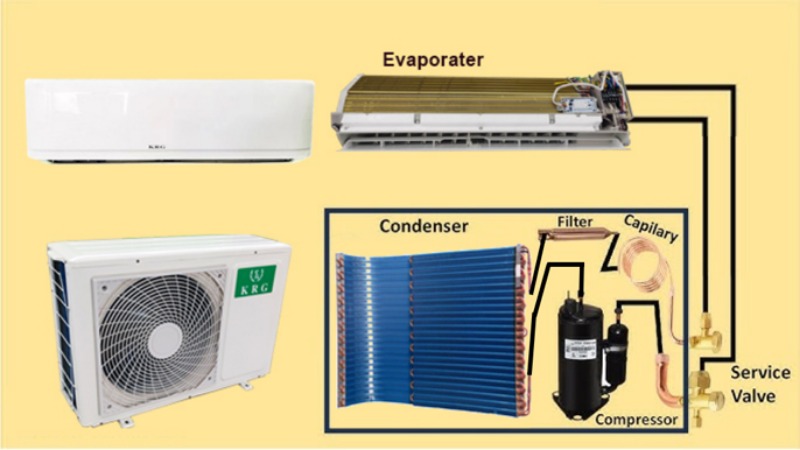
    1. Compressing: convert low-pressure gas into high-pressure, high-temperature gas


    At a state of low pressure and low temperature, the refrigerant is sucked in by the compressor; after being compressed, it becomes high pressure and high temperature. At this time, the temperature of the refrigerant is much hotter than outside of the room.


    2. Condensing: release heat outside, convert refrigerant from gas to liquid


    The high-pressure, high-temperature refrigerant (gas state) goes into the condenser (copper pipe + fins), changing from a gas state into a liquid state and releasing heat to the air outside through copper pipes.

    The key point here is the process from gas to liquid will release much heat.


    3. Throttling: sudden decrease of pressure, preparing for the heat absorption


    Being condensed, the refrigerant becomes high pressure with a medium temperature but in a liquid state.

    After passing through a small part (capillary or electronic expansion valve), the refrigerant pressure decreases suddenly, and together with the temperature, it becomes a low-temperature, low-pressure state mixed with gas and liquid.


    4. Evaporating: absorb heat inside, create "cooling"


    The low-pressure, low-temperature refrigerant (gas state) goes into the evaporator (copper pipe + fins). At this time the indoor temperature is higher than the refrigerant, which absorbs heat from the refrigerant through copper pipes and changes from a liquid state into a gaseous state.

    Evaporating is the process of absorbing heat, so that's why the indoor air has been cooled.


    IV. Why is the phase transition so important to the refrigerant?


    If the refrigerant uses normal liquid or gas, then the cooling efficiency will be very low.

    Absorbing or releasing a large amount of potential heat during the phase transition is the biggest value for the refrigerant. With the same temperature difference, it will transfer more heat than normal substances.

    That's why, by flowing backwards and forwards in the copper pipe, a little refrigerant could cool and heat the whole room.


    V. Heat exchange efficiency depends on the design of copper deeply


    Whether the refrigerant could work efficiently, it not only depends on itself but also on if:


    The copper pipe size is reasonable;

    The piping length is suitable;

    The fins structure and the distance between pipes;

    The inside surface of the copper pipe is clean and oil-free;

    Those details will directly affect the cooling speed, COP/EER, systematic stability, and lifespan.

     

  • What Are the Differences Between Air Speed, Air Volume, and Air Pressure?

    Sometimes, people comment on an air conditioner that it has high air volume but it's not cold, or it operates loudly but the room temperature decreases slowly, or the air speed is strong but there is no feeling in a distant place.

    Behind these experiences, they are related to three conceptions that are easily confused: air speed, air volume, and air pressure. They are at different levels but determine the comfort, air supply distance, and cooling performance at the same time.


    I. What is air speed? -- the wind that you had experienced


    Air speed is the velocity of the airflow with the common unit of m/s (meters per second). To put it simply, air speed determines how strong the wind blows on your face when you stand in front of the air outlet.

    The higher the air speed, the more significant the feeling of airflow; and the lower the air speed, the smoother the airflow would be. In the air conditioning, a high air speed does not mean quicker cooling; instead, it will form a feeling of direct air flow and produce noise and discomfort.


    II. What is air volume? -- the key to determine the cooling efficiency


    Air volume refers to the volume of the supplied air in the unit time with a unit of m³/h or ft³/h (cubic meters per hour, cubic feet per hour). To put it simply, air volume determines how much of the air has been processed and joined in the cooling circle.

    The higher the air volume, the quicker the air circulation inside, and the more even the overall temperature will be; on the contrary, the lower the air volume, the less even the temperature will be.


    III. What is air pressure? -- the ability to supply the air to a distance


    Air pressure, or static pressure, refers to the ability of the system to overcome the resistance; the unit is Pa. Simply, it determines whether the air would spread to a long distance and across the obstacles with stability.

    Air pressure is the key index to the central air conditioners and ducted air conditioners. Insufficient pressure will make the air strong near the vent but weak while far from the vent, and the longer the vent, the worse the cooling performance will be. Sufficient air pressure will provide an even air volume at every vent and supply air stably in the large spaces.


    IV. The relationship between them is not "the bigger the better" but a match


    There is a common misconception that the stronger the air blow, the better the air conditioner will be. In fact, high air speed with small air volume and low air pressure will only make it cool around the air outlet. Reasonable air speed with high air volume and enough air pressure will make the whole room have an even and comfortable temperature.


    Item

    What it determines

    Situation when at a high level
    Airspeed The feeling of air (strong/weak) Discomfort, loud noise
    Air volume Cooling efficiency High energy consumption
    Air pressure Air supply distance Systematic noise and high energy consumption


    V. Reasons why our air conditioner is not comfortable


    1. Large room with small air volume: the cooling process is slow and the temperature difference is large.

    2. Inadequate static pressure: for the ducted air conditioners, this situation will lead to no wind at the air outlet.

    3. Force to increase the air speed: the higher the wind, the louder the noise, and the easier it is to get a headache.


    VI. How to choose among these parameters?


    · Wall mounted air conditioner/floor standing air conditioner

    Focus on whether the air volume matches with the room size. The wind needs to be smooth instead of being strong.


    · Ceiling cassette air conditioner/ducted air conditioner/central air conditioner

    The air pressure is the key point. Models with multiple vents and long pipes should come with high static features.


    · Inverter air conditioners

    Inverter models are ideal options for various spaces; they can adjust the load automatically, saving energy and providing comfort.


    We are professional air conditioner manufacturers. For more information on specifications of the air conditioners, please feel free to contact us!