{ Wall Mounted Air Conditioner }

  • Air Conditioner Matching Guide with Interior Decoration Styles

    In modern housing designs, air conditioners are not only cooling and heating devices but also a key part of the overall spatial aesthetics. As the trends of "invisible design," "all-in-one home appliances", etc. are emerging, it becomes a hot topic among more and more consumers and designers of how to keep the air conditioner meeting the comfort needs and adhering to the indoor decoration style simultaneously.


    I. Why do air conditioners need "style matching"?


    In the past, air conditioners were regarded as functional appliances, and people did not care about their installation and appearance. Nowadays, consumers pay more attention to the spatial harmony and visual cleanliness. Here are what they concern mainly:


    · The indoor unit location affects indoor aesthetics and visual balance;

    · The indoor unit color and material affect the unity of the room style;

    · The indoor unit noise and airflow affect comfort and experience.


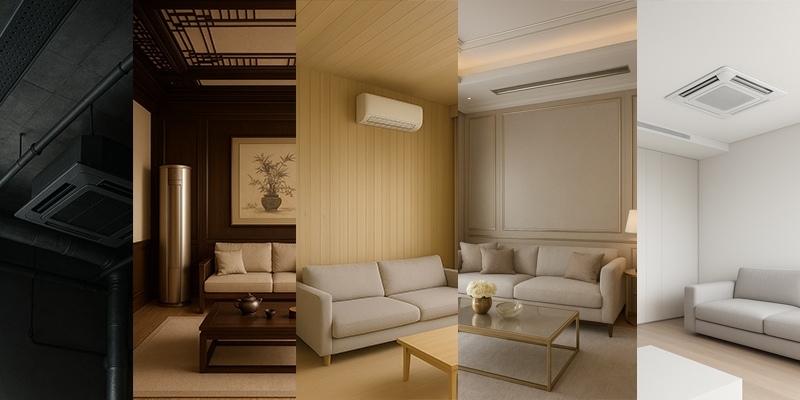
    II. Air conditioning matching suggestions for different decoration styles


    1. Modern minimalist style


    · Features: Simple lines and elegant colors with emphasis on functionality.

    · Suggested AC types: ceiling concealed duct air conditioners and ceiling concealed cassette air conditioners.

    · Selection advice: Pure white color and silver gray panels can combine together with the style of ceilings and walls.


    2. Nordic style


    · Features: Natural wood with warmness, bright space with comfort.

    · Suggested AC types: Wall mounted air conditioner (round shape), concealed duct type air conditioner.

    · Selection advice: Off-white, light gray, or matte finish cases—these colors can match with the wooden background, creating a natural visual transition.


    3. New Chinese style


    · Features: Fusion with wood and metal, systematic layout, classical charm.

    · Suggested AC types: Ceiling concealed duct air conditioners and floor standing air conditioners.

    · Selection advice: Dark brown, champagne gold, and such neutral colors; or hidden in the ceiling or wooden grids when installed.


    4. Industrial style


    · Features: Metal elements, exposed ducts and pipes, and mainly gray and black colors.

    · Suggested AC types: Exposed ducted air conditioners, ceiling cassette air conditioners.

    · Selection advice: Exposed installation, air conditioner indoor unit, and pipes are the host as the design elements; matte black and metallic silver colors adhere to the light and indoor structure.


    5. Light luxury style/modern luxury style


    · Features: High-profile, high-quality materials, simple but exquisite.

    · Suggested AC types: DC/full DC inverter VRF central air conditioning system, ultra-slim duct type air conditioners.

    · Selection advice: Hidden installation with slim-line air outlet; choose models with mirror texture to complement the overall metal design.


    III. Principles of color and material matching


    · Unity Principle: The indoor unit color should be adherable to the walls, furniture, and metal devices.

    · Understated Principle: In public spaces, the more invisible the air conditioner, the more high-profile the space.

    · Material Coordination: Matte panel air conditioners are suitable for wooden spaces; glossy and silver-gray panels are suitable for metal spaces.

    · Consistent Lines: The direction of the air vents should be parallel to the lighting troughs and ceiling lines.


    IV. Advantages of invisible installation


    In recent years, more and more families choose central air conditioners with invisible installation. The reasons for this option are


    · Elegance and cleanliness: With the air outlet visible only, the installation do not disturb the overall decor;

    · Flexible layout: The air outlet can be integrated with LED strips and curtain boxes;

    · Quietness and comfort: The outdoor unit is placed far away, keeping a quiet indoor environment.


    For light commercial and high-end residential applications, the KRG ceiling concealed duct air conditioner has become the mainstream choice, meeting both design and performance requirements with its ultra-thin body and high energy efficiency.


    The comfort and design of an air conditioner is now becoming an indispensable part of modern home decors. A good air conditioning matching solution can not only beautify our homes but also comfort us.

    From "installing an air conditioner" to "designing a comfortable space," this represents the evolution of modern home design.


  • Can an Air Conditioner Operate Under -40℃?

    To those living in extremely cold regions, a common question comes when it is needed to heat by an air conditioner in winter: can the air conditioner outdoor unit operate freely in an extremely cold environment or not? Particularly under the ultra-low temperatures of -30℃ and -40℃, is the air conditioner able to supply reliable heat?


    1. What are the limits of traditional air conditioners?


    Traditional non-inverter or inverter air conditioners are available to operate under the ambient temperature of -7℃ to -15℃. When the temperature goes further lower, the situations below will occur:


    i). Apparent decrease of heating capacity;

    ii). Severe frost on the outdoor unit and defrosting affect heating performance.

    iii). The compressor is hard to start or does not even start.


    In case of that, traditional air conditioners can not start freely under the temperature of -30℃ and even -40℃.


    2. Advanced technology: EVI technology


    For cold regions, air conditioner manufacturers will develop the air conditioner models with EVI (Enhanced Vapor Injection) technology. By adding additional jet ports for gas in the compressor, the technology allows the refrigerant to keep enough pressure and flow under the extreme cold condition, improving the heating ability under low temperature. Adopted with EVI technology, the air conditioners could provide stable heating under -25℃ to -30℃ environments. Some high-end models are claimed to start freely under -35℃.


    3. Impossibility under -40℃


    Under a -40℃ environment, even the high-end air conditioning models are still facing great challenges:


    i). The starting difficulty: Thickening of the refrigerant oil makes it difficult to lubricate the compressor.

    ii). The decreasing heating capacity: Even if the system can start, the heating capacity will be significantly reduced.

    iii). The increasing power consumption: Even if the system can start, the heating capacity will be significantly reduced.


    Common solutions to the -40℃ environments are ultra-low temperature air source heat pumps (customized commercial/engineering machines), rather than ordinary household air conditioners, or electric auxiliary heating and gas heating with air conditioning used in conjunction.


    4. Options for the cold areas.


    For regions in the Mongolia plateau, Northern Russia, and Canada, it is recommended to choose low-temperature heat pump air conditioners with EVI technology or directly choose air source heat pump heating units, whose operating limit can be extended to -35℃ or even -40℃, or combine them with backup heating methods such as floor heating and electric heaters to ensure comfort and safety in extreme weather.


    Traditional air conditioners can't start at -40°C. Even some high-end low-temperature heat pump models claim to be able to operate, but they require extremely demanding technical support and operating environments. For users in extremely cold regions, choosing a professional ultra-low-temperature heat pump product is the only reliable way to heat your home in winter.